
SMART MONEY DIASPORA

Build wealth beyond borders. Create a legacy that lasts.

Earning money vs owning assets: a green plant growing from a stack of coins

Earning Money vs Owning Assets: What’s the Difference?

Earning money vs owning assets is a difference many of us only notice years after moving abroad. You earn in Denmark, Germany, the UK or the US. Every month, part of that salary goes to rent, part to your own children, and part to parents, siblings or school fees back home. A few years in, many of us notice something uncomfortable: the salary went up, yet we still feel one missed payslip away from trouble.

The reason usually comes down to one distinction: earning money vs owning assets. Moving abroad can increase your earning power. But earning more is only the beginning of building wealth.

In this post we explain the difference in plain English, show how earned money becomes productive capital, and walk through worked examples with real Danish and Kenyan numbers. The goal is not to stop supporting family. It is to support them today while building assets for tomorrow.

Earning Money vs Owning Assets: What’s the Difference?

Earning money means trading your time and skills for income: salary, wages, overtime, freelance fees. When you stop working, that income stops.

Owning assets means holding something of value. Some assets can produce income without your daily labour. Others may grow in value. And some only look like assets while quietly costing you money.

TypeExamplesWhat to expect
Income-producing assetsRental unit, dividend-paying shares, a farm or business that sells its outputCan pay you regularly, but income is never guaranteed and often needs management
Assets that may appreciateIndex funds that reinvest returns, land in a growing areaMay rise in value over time, but pay you little or nothing until you sell
Things that consume moneyAn empty house, a car on credit, unused landCost you every year without a financial return

This is why we measure wealth as net worth: everything you own minus everything you owe. A large salary, or an expensive house, does not tell you whether you are actually building wealth.

How Earned Money Becomes Wealth

At Smart Money Diaspora, we believe wealth grows when capital is put to productive use. We think of it as a simple chain:

Capital → Asset → Income → Reinvestment → Wealth

Owning assets: a glass jar of coins with a plant growing from it, showing capital put to work
  1. Capital. A deliberate portion of your surplus income is set aside. Not what is left at the end of the month, but what you move first.
  2. Asset. That capital buys something productive: a diversified fund, a carefully checked rental unit, equipment for a family farm.
  3. Income. The asset produces returns, rent or profit.
  4. Reinvestment. Part of that income goes back in, so the asset base keeps growing.
  5. Wealth. Over years, the assets can support you and your family, and eventually the next generation.

Your salary pays for your life today. The money you deliberately set aside can finance the assets that support your life tomorrow.

Why Earning More Abroad Is Only the Beginning

As we explained in Why a High Salary Doesn’t Automatically Make You Wealthy, income is a flow and wealth is a stock. Money comes in each month, then flows out again.

For Africans living abroad, more claims sit on that flow. There is rent in an expensive city, transfer fees, and the regular family support often called Black Tax. These responsibilities matter. Still, without a plan, the gap between earning and owning rarely closes by itself.

There is also a quieter risk. Our income is often tied to one employer in one country. If that changes, the salary can stop within weeks. Productive assets add a second line of support that does not depend on a single payslip.

A Worked Example: Two Colleagues, Same Salary

Take an illustrative case. Grace and David both work in Copenhagen, take home about DKK 30,000 a month and support family in Kenya.

Grace pays her bills and family support, then spends what is left. David does the same, except that on payday he first moves DKK 1,400 into a low-cost global index fund inside an aktiesparekonto, the Danish share savings account.

Our assumptions: an average return of 6% a year, minus 0.3% in fund fees, so 5.7% before tax. The aktiesparekonto is taxed at 17% on a mark-to-market basis: each year the tax is worked out on the account’s value at 31 December, so you can owe tax on gains even if you have not sold anything. Taking 17% off each year’s gain leaves about 4.7% a year (5.7% × 0.83), and we compound that monthly. All figures are estimates; markets fall as well as rise, and in a falling year there is no tax but a loss to carry forward.

AfterDavid has paid inEstimated portfolio value
5 yearsDKK 84,000about DKK 95,000
10 yearsDKK 168,000about DKK 214,000

Note what this table shows: a portfolio value, not cash in David’s account. Many global index funds reinvest their returns rather than pay them out. If, after ten years, David chose to withdraw 4% a year (a common rule of thumb, not a promise), that would be roughly DKK 8,600 a year, or about DKK 700 a month.

Both colleagues still earn the same salary. Yet David now owns capital that can keep working, while Grace has only the payslip.

One detail matters: the aktiesparekonto has a ceiling of DKK 174,200 in 2026, adjusted each year. Your room for new deposits is measured against the account’s market value at the end of the previous year, not just what you paid in. At today’s ceiling, David’s account would reach the limit in about year nine. From then on, he would invest the rest through a normal investment account, which is taxed differently. For simplicity, our table treats all ten years as if they were inside the account.

Building Productive Assets Back Home

Global funds are only one route. Many of us also want assets in Africa: a rental unit, a family farm, a small business. These can work well, but they are rarely passive.

Imagine a small residential unit in Kenya rented for KES 20,000 a month. Kenya taxes residential rent on the gross amount, with no deduction for costs. For landlords who are tax-resident in Kenya, the monthly rental income tax is 7.5% of gross rent, a rate in force since 1 January 2024. For landlords living abroad, the Finance Act 2026 introduced a separate non-resident rental income tax of 30% of gross rent, filed and paid by the 20th of the following month, unless a tenant or agent in Kenya withholds it for you. Your tax residency therefore changes the result a lot, so check your own position with KRA.

Monthly, KES (estimates)Kenya-resident landlordLandlord living abroad
Rent received20,00020,000
Rental income tax1,500 (7.5%)6,000 (30%)
Agent or caretaker (10%)2,0002,000
Repairs and empty months2,0002,000
Left for you14,50010,000

So the same unit can earn very different amounts, and someone still has to collect rent, find tenants and fix the roof. Farms and businesses need even more active management. Our case study on turning a family home into an income-producing farm shows what that looks like in practice.

Before sending money for any investment back home, check six things:

  • Ownership: is the title deed clean, and whose name is on it?
  • Operating costs: what will it cost every month, not just to buy?
  • Management: who runs it day to day, and how will you check?
  • Demand: will tenants or customers actually pay?
  • Liquidity: how quickly could you sell if you needed the money?
  • Fraud risk: have you verified the seller, the land and the paperwork independently?

An investment in Africa is not automatically profitable or safe. Nor is it automatically risky. It needs the same careful checks as any other.

From Earner to Owner in Five Steps

The capital-to-wealth chain is the philosophy. In practice, we follow the same order with every reader: Understand → Stabilize → Grow → Invest → Legacy.

  1. Understand. Calculate your net worth, map your income and expenses, and list your existing assets and debts.
  2. Stabilize. Build an emergency reserve, deal with expensive debt and set a sustainable family-support budget. Our guide on how much to send home each month gives a simple formula.
  3. Grow. Increase the surplus available for saving and investing, without neglecting essential family needs.
  4. Invest. Allocate capital to diversified or carefully evaluated productive assets, with a plan for monitoring them. Explore the basics on our Investing for the Diaspora page.
  5. Legacy. Protect ownership, document beneficiaries, plan succession and teach the next generation how wealth is managed. Our Wealth & Legacy section covers this, and Spend the Income, Keep the Capital shows how an asset can support parents without eating your savings.

This order matters. Investing before you are stable often means selling at the worst moment when a family emergency arrives.

Things That Look Like Assets but Are Not

Some purchases feel like ownership but quietly take money out of your pocket:

  • An empty house back home. It costs a caretaker, repairs and rates, yet earns nothing.
  • A car bought on credit. It loses value every year while you pay interest.
  • “Guaranteed” high-return schemes. If it sounds too good to be true, it usually is. We list more traps in Top 10 Financial Mistakes to Avoid When Moving Abroad.
  • Land without a clean title. If you cannot prove you own it, you do not fully own it.

A useful test: does it put money in your pocket, or is it likely to grow in value? If neither, it is spending, however good it looks.

What Is Your Money Building?

The real question is not only how much you earn abroad. It is what the money you earn is building.

To help you take the first step, we put together the Smart Diaspora Money Starter Kit. It gives you a starting point to work out your net worth, plan family support, build an emergency reserve and identify how much you can invest each month.

Get the free Smart Diaspora Money Starter Kit

We are also building a Diaspora Wealth Planner and an investing course for people living abroad. Starter Kit readers will hear about them first.

Next in our From Income to Wealth series: How Immigrants Can Start Building Wealth Abroad. Explore more on our Investing page.

Smart Money Diaspora shares financial education, not personal financial, tax or legal advice. Tax rules, rates and thresholds change and depend on your residency and situation. The figures in this post are illustrative estimates, and investments can fall in value. Please check current rules with Skattestyrelsen, the Kenya Revenue Authority or a qualified adviser before making decisions.

Sources: Skattestyrelsen: Aktiesparekonto · KRA: Residential rental income tax · PwC Worldwide Tax Summaries: Kenya, taxes on personal income · EY: Kenya enacts Finance Act, 2026 · Citizen Digital: KRA issues new tax guidance for Kenyans living abroad with rental property

A plant growing from coins: turning a high salary into lasting wealth

Why a High Salary in the Diaspora Doesn’t Automatically Make You Wealthy

Moving abroad can change your financial life, and for many of us it brings a high salary for the first time.

A plant growing from coins: turning a high salary into lasting wealth
Photo: micheile henderson / Unsplash

You may go from earning very little to earning a salary that once seemed unimaginable. You may finally be able to pay your bills comfortably, send money home, travel, buy better things and provide opportunities for your children.

But there is a problem that many immigrants discover only after several years: you can earn a high salary and still not be building wealth.

A higher income can give you a better lifestyle. It can give you more choices, and it can reduce financial stress. But a high salary doesn’t automatically make you wealthy, because income is not wealth. Understanding the difference can completely change how you manage your money abroad.

How a High Salary Can Create the Illusion of Wealth

Imagine two people living in the same country. They both earn €4,000 a month after tax, and both get the same small pay rise each year. On paper, they are in exactly the same financial position. Their financial futures, however, could look completely different.

Person A earns €4,000 and gradually increases their lifestyle:

  • a bigger apartment and a newer car
  • more holidays and restaurants
  • more subscriptions
  • more financial support for family, sent whenever someone asks

Every salary increase creates another reason to spend more. At the end of the month, there is little left, even on a high salary. This is often called lifestyle inflation, and psychologists describe the same pattern as the hedonic treadmill: we quickly get used to more, so more never feels like enough.

Person B also earns €4,000. But they deliberately decide that every month some of their income must do something beyond paying for today’s life. So they:

  • build an emergency fund
  • pay down expensive debt
  • invest 10% of their pay, €400 a month, on payday
  • build or buy productive assets over time
  • increase their savings whenever their income grows

Here is roughly where they could stand after ten years, assuming both get a 3% pay rise each year and Person B’s investments grow by 6% a year on average:

After 10 years Person A Person B
Total earned About €550,000 About €550,000
Total invested Close to €0 About €55,000
Value of investments Close to €0 About €74,000
Emergency savings Unpredictable Three to six months of costs
If the job stopped Pressure within weeks Months of breathing room

The two people still have similar salaries. Their net worth, however, is completely different, and about €19,000 of Person B’s money came from growth, not from work. That is the difference between earning money and building wealth.

These figures are an illustration, not a forecast. Real returns go up and down, and some years are negative.

So, What Is Wealth?

Wealth is not simply how much money comes into your bank account every month. Income is a flow; wealth is what builds up and stays.

Income Wealth
What it is Money you receive: salary, bonuses, side income What you own minus what you owe
Examples Your monthly pay Savings, investments, pension, property, a business
If you stop working It stops It keeps working for you
What it buys Your lifestyle today Security and choices tomorrow

A simple way to think about wealth is:

Net worth = What you own − What you owe (see a fuller definition of net worth)

This is why someone on a high salary can have little wealth, while someone with a more modest income can gradually build significant wealth.

Here is a quick test: if your salary stopped tomorrow, how many months could you live on what you own? That number, not your payslip, shows your real financial position.

So the question is not only: How much do you earn? A more important question is: What is your income building?

Why a High Salary Abroad Is Harder to Turn Into Wealth

Building wealth as an immigrant can be more complicated than simply following a traditional personal-finance formula, because your financial life may cross borders. For example:

  • you earn your salary in Denmark
  • your parents live in Kenya
  • your children have expenses in the country where you live
  • you own land or property back home
  • you save for retirement where you live while also building something for your family back home
  • relatives depend on you financially

Your money can therefore have several destinations before you even think about investing.

There is also a quieter pressure. Back home, a job abroad can look like wealth. Family may not see the rent, the tax or the cost of childcare. As a result, expectations can grow faster than your actual surplus. At the same time, countries that pay a high salary often have high taxes and high living costs, so a salary that looks huge when converted into your home currency may leave much less than people imagine.

This is one of the reasons we believe diaspora finances need to be viewed differently. You are not necessarily managing one financial life. You may be managing several financial responsibilities across countries at the same time.

Five Things That Turn a High Salary Into Wealth

A high salary is useful, but salary alone is not the destination. Your income needs a system.

1. Spend Less Than You Earn

This sounds obvious, but it is the foundation. If you earn €4,000 and spend €4,000 every month, your salary has supported your lifestyle, but it has not increased your wealth. And if you spend €4,300, a higher salary will not solve the underlying problem.

The goal is not to live an extremely restrictive life. It is to create a surplus. That surplus is the money that can eventually become savings, investments and assets. The most reliable way to protect it is to pay yourself first: move money to savings and investments on payday, then live on the rest.

2. Build Financial Stability First

Before focusing heavily on investing, you need a financial foundation. That may include:

  • an emergency fund
  • managing high-interest debt
  • appropriate insurance
  • a realistic monthly budget
  • a sustainable family-support plan
  • understanding your regular financial commitments

This matters because wealth building becomes much harder when every unexpected expense forces you to sell investments or borrow money. Stability gives you the ability to think long term.

3. Increase the Amount of Income You Keep

A salary increase does not automatically increase wealth. What matters is what happens to the additional income.

Suppose your salary increases by €500 a month. You could allow the entire €500 to disappear into a more expensive lifestyle. Or you could decide that part of it will increase your savings and investments. A simple starting rule is half and half: €250 for today, €250 for your future.

This does not mean you should never enjoy your income. You should. But every salary increase creates an opportunity to ask: How much of this increase will improve my lifestyle, and how much will improve my financial future? That is a very different way of thinking about a pay rise.

4. Turn Surplus Income Into Assets

This is where the transition from income to wealth really begins. Money sitting in your account provides security and liquidity. Over many years, though, cash slowly loses value to inflation. Many people build wealth by owning assets that can grow in value or produce income. Depending on your circumstances, these might include:

  • investment funds and ETFs
  • stocks and bonds
  • pension investments
  • property
  • a business
  • productive agricultural assets

The important distinction is this: you are no longer using all your income simply to maintain your lifestyle. You are using some of today’s income to acquire something that may contribute to your future financial position.

Of course, every investment carries risk. The appropriate assets depend on your country of residence, financial circumstances, time horizon, tax situation and risk tolerance. Our Investing section explains the basics. But the principle remains: income pays for your life; assets can help build your wealth.

5. Give Your Wealth Time

Wealth rarely appears overnight. One of the biggest advantages you have is time. Regular contributions accumulate, investments can grow, and businesses can expand. Similarly, property can appreciate or generate income, and productive assets can add cash flow.

The earlier you begin building assets, the longer your money has the opportunity to work. This is one reason delaying wealth building indefinitely can be costly. You do not need to start with a large amount. You need a system that you can sustain.

The Diaspora Wealth Equation

At Smart Money Diaspora, we think about wealth building as a journey:

Income → Stability → Surplus → Assets → Wealth → Legacy

Let’s break that down:

  1. Income: you earn money through employment, business or other sources.
  2. Stability: you create a financial foundation that can withstand unexpected expenses.
  3. Surplus: you consistently have money left after your essential commitments.
  4. Assets: you use some of that surplus to build ownership.
  5. Wealth: your assets and financial resources begin creating greater security and choices.
  6. Legacy: what you build can eventually benefit your children, family and future generations.

This is why earning more is only the beginning.

What About Supporting Family Back Home?

This is one of the biggest questions for immigrants. You may be thinking: “How can I build wealth when my family needs help?”

The answer isn’t necessarily to stop supporting your family. For many immigrants, family support is an important responsibility. The challenge is making that support sustainable.

If every increase in your income simply results in sending more money home, you may find yourself earning more without becoming financially stronger. That is why we believe family support needs to be part of your financial plan, not something that happens after everything else. You need to know:

  • how much you can sustainably afford
  • which expenses are recurring, which are emergencies and which are one-off
  • what responsibilities you can share with others
  • whether some support can eventually become a productive asset

This is the thinking behind our Black Tax series. Instead of asking only “How much money can I send?”, you can eventually start asking: “How can some of the money I put into my family create something that helps the family become more financially independent?” That is a very different conversation.

Read more in Black Tax: What It Is, Why It Exists and How to Make It Sustainable, and set your number with our simple monthly budget for family support.

A Simple Example: What Job Should Your Surplus Do?

Let’s go back to the person earning €4,000 a month. Suppose their essential expenses and family commitments take €3,200. That leaves €800.

The important question is not “What can I buy with the €800?” It is: “What job should the €800 do?”

Here is one possible split:

Job Amount Why
Emergency fund €200 Until it covers three to six months of costs
Long-term investing €300 Pension top-up or a low-cost index fund
A specific goal €150 A home deposit, school fees or a project back home
Enjoyment €150 Because a plan you can live with is a plan you keep

The exact amounts will depend on your circumstances. The point is that the surplus has a purpose, and over time, those decisions make a significant difference.

What If You Already Earn a High Salary but Have Little Wealth?

You are not alone. And you do not need to earn dramatically more before you begin. Start by understanding where you are today, then follow these seven steps:

  1. Calculate your net worth. List what you own and subtract what you owe. You may be surprised by the result.
  2. Track your cash flow. Know exactly how much comes into your household and where it goes.
  3. Identify your financial leaks. Look at lifestyle inflation, unused subscriptions, expensive debt and spending that happens without intention.
  4. Create a sustainable family-support amount. If you support people back home, make it a planned part of the budget.
  5. Build your financial foundation. Create appropriate emergency savings and deal with expensive debt.
  6. Start acquiring assets. Once your foundation is in place, put money toward long-term assets according to your goals and risk tolerance.
  7. Grow the system when your income grows. When your salary rises, don’t automatically increase every expense. Increase the amount going toward your future too.

For more lessons from life abroad, read What I Wish I Knew About Money Before Moving Abroad and the Top 10 Financial Mistakes to Avoid When Moving Abroad.

The Goal Isn’t to Look Wealthy

This is perhaps one of the most important lessons. Even on a high salary, it is possible to drive an expensive car and have very little net worth. A beautiful home can come with heavy debt. Someone can send large amounts of money home every month and still have no financial security of their own. Meanwhile, a person on a relatively ordinary salary can be steadily building investments, savings and productive assets.

Wealth is not always visible. Sometimes wealth looks like:

  • an emergency fund nobody knows about
  • investments you rarely talk about
  • a pension you consistently contribute to
  • a business quietly growing
  • a piece of land that produces income
  • a debt that has finally been paid off
  • a financial plan that allows you to say no when you need to
  • assets your children may eventually inherit

That is the kind of wealth we should be thinking about.

Your High Salary Should Give You More Than a Lifestyle

Moving abroad can create an extraordinary opportunity. But the opportunity isn’t simply to earn more money. It is to use that increased earning potential to create greater financial security, ownership and choices.

Your first salary abroad may help you survive. Your next salary may help you stabilize. Eventually, though, your financial strategy should answer a bigger question: What am I building with the money I earn?

Because the ultimate goal isn’t simply a higher income. It is to reach a point where your financial position gives you choices about:

  • where you live
  • the work you do
  • how you support your family
  • your children’s future
  • and, eventually, what you leave behind

Build Wealth. Create Choices. Leave a Legacy.

At Smart Money Diaspora, our approach is simple: Understand → Stabilize → Grow → Invest → Legacy.

You don’t have to master everything at once. Start by understanding your money. Next, build stability and create a surplus. Then turn that surplus into assets, and give those assets time to grow. That is how a high salary abroad can become more than a bigger lifestyle. It can become the foundation for lasting wealth.

Free resource: the Smart Diaspora Money Starter Kit, a practical starting point for organizing your money, goals and wealth-building journey. Get the free Starter Kit →

What to read next: How Immigrants Can Start Building Wealth Abroad (coming soon). We’ll take the next step and look at how to move from earning and saving to deliberately building wealth while living abroad. Until then, explore our Money section.

Smart Money Diaspora shares financial education, not personal financial advice. The examples in this post are illustrations; investment returns are not guaranteed and can be negative. Consider speaking to a licensed adviser about your own situation.

Spend the Income, Keep the Capital: How to Build an Income for Your Parents

For many of us living abroad, supporting our parents is not a choice. It’s love, gratitude and responsibility, all rolled into one monthly transfer.

However, there’s a quiet question behind that transfer that few of us ask out loud: what happens if, one day, I can’t send it?

Maybe you lose your job. Perhaps you have a child, or your own costs rise. In some cases, you simply reach a point where you need to save for your own retirement. Meanwhile, your parents still need to eat, pay bills and see a doctor.

That’s why this final part of the Black Tax series is about a different approach. Instead of sending money forever, you build a pot of capital, invest it, and let your parents live on the income it produces. The capital stays. Only the returns are spent.

In part 3, I shared how I turned our family home into an income-producing farm. This post takes the same idea further, from livestock to investments, rental income and small businesses. In each case, the principle is the same: build an asset, and let the cash flow carry the cost.

The Black Tax Series

part 1: Understand Black Tax

part 2: Create a Family Support Budget

part 3: Turn a Family Asset Into Income

Part 4: Build Capital That Produces Family Income (you’re here)

New to the series? Start with part 1 →

Key Takeaways

  • Spend the income, keep the capital. Your parents live on the returns, while the original investment stays intact.
  • To estimate how much capital you need, use a simple formula: yearly need ÷ yearly return.
  • Cash-flow assets include government securities, money market funds, fixed deposits, dividend funds, rental property, farming and small businesses.
  • Protect the capital from inflation, currency swings, misuse and scams.
  • The cash flow can do more than pay bills. It can also fund a family business, without touching the capital.

The Idea: Capital and Income Are Not the Same Thing

As an accountant, I often think about money in two buckets.

Capital is the money you put to work: the investment, the asset, the tree. Income is what that capital produces: the interest, the rent, the milk, the fruit.

Most family support works like this: every month, money leaves your account, gets spent, and disappears. Next month, you start again from zero. In other words, you’re paying for the fruit, over and over, without ever planting a tree.

The capital approach flips that around:

Monthly transfers Spend the income, keep the capital
Where the money comes from Your salary, every month The returns from an investment
What happens to the money Spent and gone The capital stays; only the income is spent
If you lose your job Support stops Support continues
After 10 years Nothing left to show An asset that’s still working
What you’re building Ongoing reliance on your salary A source of income

Of course, this doesn’t mean monthly transfers are wrong. In many families, they’re essential, especially at the start. Rather, the goal is to gradually shift part of your support from your salary to an asset, so that over time, your parents depend less on you and more on something that keeps producing.

Think of it like planting a tree. You don’t eat the tree. You eat the fruit, and the tree keeps growing.

How Much Capital Do You Need?

This is where most people give up, because the number sounds big. However, the calculation itself is simple:

Before You Invest, Know These Three Numbers

1. Monthly family need: how much do your parents actually need each month?

2. Annual amount required: monthly need × 12.

3. Sustainable income from the asset: what can the investment realistically produce each year, after taxes, fees and allowing for inflation?

Then:

Capital target = Annual family need ÷ Sustainable annual income rate

Let’s walk through an example. Say your parents need €150 a month to cover food, utilities and basic costs. That’s €1,800 a year.

Next, the capital you need depends on the return your investment produces. (The rates below are for illustration only. Actual returns vary by country, product and year, so always check current rates. Also, to protect the capital from inflation, use the return your parents can actually spend, as explained further below.)

If the investment returns… Capital needed for €1,800 a year
6% a year €30,000
8% a year €22,500
10% a year €18,000
12% a year €15,000

One important reality check: this calculation is a planning illustration, not a guarantee. A 10% return doesn’t mean you’ll receive exactly 10% every year. Returns can change, taxes and fees can reduce what you actually receive, and some investments can lose value. The goal, therefore, isn’t simply to find the highest return. It’s to build a sustainable income stream while protecting the capital as much as reasonably possible.

You Don’t Have to Fund the Whole Thing

The biggest mistake is thinking you need the entire amount before you can start. You don’t.

Instead, you can start small and let the asset gradually take over part of the responsibility. Maybe today you send your parents €150 every month. Over time, an investment might cover €30 of that. Later, it might cover €50, and eventually €80. Meanwhile, the amount coming from your salary gets smaller, while the amount coming from the asset gets larger.

Here’s how that can work in practice:

1. Start with what you have. For example, €4,500 at 10% produces about €450 a year, roughly a quarter of a €1,800 need.

2. Keep sending the rest from your salary for now.

3. Add to the capital every year, from a bonus, a tax refund or part of your savings.

4. Reduce your monthly transfer as the investment income grows.

The goal isn’t to stop supporting your family. The goal is to stop being the only source of support.

Assets That Produce Cash Flow

Not every investment is suitable for this. Some assets, like land held for the future, may grow in value but produce no income today. For family support, you need cash-flow assets: things that pay you regularly while you still own them.

Here are the main options, from lower to higher effort.

1. Government securities

Treasury bills and government bonds pay interest, and in many countries they’re considered among the safer local investments. In Kenya, for example, they can be bought through the central bank or a licensed broker, and bonds typically pay interest twice a year. For that reason, they suit regular family support well.

2. Money market funds

A money market fund pools money from many investors into short-term, lower-risk instruments. Usually, you can add money easily and withdraw within days. As a result, many families use them as the “bank account” from which a monthly allowance is paid.

3. Fixed deposits

A fixed deposit locks your money with a bank for a set period at an agreed interest rate. It’s simple and predictable. On the other hand, your money is tied up until the term ends.

4. Dividend-paying funds or shares

Some companies and funds pay part of their profits to investors as dividends. Over the long term, they can grow both income and capital. However, dividends and share prices can fall, so they suit money you won’t need for years.

5. Rental property

A rental room, a small block of flats or a commercial space can produce monthly rent. Moreover, it’s tangible and familiar for many families. Even so, property needs management, repairs and tenants who pay on time, which is harder from abroad.

6. Agricultural assets

Livestock, poultry, fruit trees or crops can produce regular income. This is exactly what I did with our family home, which you can read about in part 3 of this series. That said, farming needs the right person on the ground, good records and a reserve for difficult seasons.

7. A small business

A shop, a posho mill, a salon or a transport business can produce daily income. Of all the options, it has the highest potential and the highest risk, and it depends heavily on the person running it.

Comparing the options

Asset Effort to manage Income Main risk
Government securities Low Regular interest Inflation, currency
Money market funds Low Regular, flexible Fund quality, inflation
Fixed deposits Low Fixed interest Locked money, inflation
Dividend funds or shares Low to medium Varies Market falls
Rental property Medium to high Monthly rent Vacancies, repairs
Farming High Seasonal or daily Disease, weather
Small business High Daily, varies Management, failure

For many diaspora families, a lower-effort, regulated investment may be easier to manage initially, particularly when the goal is to create predictable cash flow from abroad. Later, once that foundation is in place, a higher-effort asset like rental property, farming or a business can be added. Ultimately, though, the right choice depends on your country, tax position, risk tolerance, time horizon and circumstances.

Protecting the Capital

The whole idea only works if the capital survives. Therefore, protecting it matters just as much as choosing the right asset.

Don’t spend all the interest: beat inflation

This is the mistake most people don’t see coming. Prices rise every year, so if your parents spend every shilling of interest, the capital slowly loses its buying power. After ten years, the same capital buys far less food.

The solution is simple: reinvest part of the return. For example, if the investment earns 10% and inflation is 6%, your parents could spend around 4% and you reinvest the rest. That way, the capital keeps pace with rising prices, and so does the income.

Spend the real return. Reinvest enough to keep up with inflation.

Watch the currency

When you invest in your home currency, your returns are earned in that currency too. That’s fine for local costs like food and school fees. However, if the currency weakens, the capital is worth less in euros. So if you’re investing a large amount, it may make sense to spread it across more than one currency.

Keep control of the capital

For the same reason you’d protect any investment, keep it in your name, or in a structure you control. Then pay the agreed income to your parents. This isn’t about mistrust. Rather, it protects everyone from pressure to “just use some of the capital this once.”

Agree the rules up front

Talk openly with your parents and siblings about how it works:

  • The capital is not touched, except in a true emergency agreed by everyone.
  • Only the income is paid out, on a fixed day each month or quarter.
  • Big costs are planned separately, not taken from the capital.

Avoid “too good to be true”

Finally, be very careful with schemes promising guaranteed high returns, especially when they’re sold through friends, churches or WhatsApp groups. Before investing, check that the provider is licensed by the relevant regulator in that country. If the promise sounds too good to be true, it usually is.

Beyond Bills: Using the Cash Flow to Start a Business

Once the basics are covered, the cash flow can do something even more powerful: create new income.

For example, imagine the investment income covers your parents’ food and utilities, with a little left over each quarter. Instead of spending that surplus, the family could save it and use it as seed capital for a small business, perhaps poultry, a kiosk, or tailoring for a sibling who’s ready to work.

The key rule stays the same: the business is funded from the income, never from the capital. As a result, if the business struggles, your parents’ basic income is still safe.

Here’s how that can grow over time:

In this way, one asset can lead to another. Similarly, our farm started with one cow and four sheep, and the animals that were born became new assets in their own right. Likewise, a well-run business can eventually produce enough to add to the capital, so the whole system keeps growing.

In fact, the farm taught me something important: an asset doesn’t have to be large to be useful. It has to be productive, managed properly and allowed to grow.

One cow produces milk. Sheep reproduce. The milk generates cash, and the cash maintains the home. Meanwhile, the animals themselves remain assets. The same principle applies to financial investments:

The asset is the engine. The income is what you use.

A few guidelines help:

  • Start small, with money the family can afford to lose.
  • Release money in stages as the business shows results.
  • Choose the right person to run it, someone willing and able.
  • Keep simple records of sales and costs, just as we do on the farm.

That way, family support stops being only a cost. Instead, it becomes the start of a family enterprise.

Your Step-by-Step Plan

If you’d like to start, here’s a simple path to follow.

1. Know the need. First, work out your parents’ real monthly gap, as described in part 2 of this series.

2. Protect yourself first. Before investing for family, make sure your own emergency fund is in place.

3. Calculate the target. Next, use the formula: yearly need ÷ yearly return you can spend.

4. Choose a low-effort asset to begin with, such as government securities or a money market fund, from a licensed provider.

5. Start with what you have. Even a quarter of the target is a meaningful beginning.

6. Agree the rules with your parents and siblings: capital untouched, income paid on a fixed day.

7. Keep sending the rest from your salary while the asset grows.

8. Add to the capital whenever you can, and reinvest part of the returns.

9. Review once a year. Then, as the income grows, reduce your monthly transfer.

10. Consider a second asset later, such as rental income, farming or a small business, funded from the surplus.

Above all, remember that this is a long game. Every euro you move from “monthly cost” to “working capital” makes your family more secure, and makes you a little freer.

Frequently Asked Questions

What does “spend the income, keep the capital” mean? It means investing a lump sum and living only on the income it produces, such as interest, dividends or rent. Because the original capital stays invested, it keeps producing income year after year.

How much do I need to invest to give my parents a monthly income? Divide the yearly amount they need by the yearly return you can spend. For example, €1,800 a year at a 10% return needs about €18,000. However, you can start with less and build up over time.

What are good income-producing investments back home? Lower-effort options include government securities, money market funds and fixed deposits from licensed providers. Higher-effort options include rental property, farming and small businesses. Always check current rates and the provider’s regulation.

Can investment income be used to start a business? Yes. Once your parents’ basic needs are covered, any surplus income can be saved as seed capital for a small family business. Just make sure the business is funded from the income, never from the capital.

The End of the Series, the Start of a Legacy

When I started this series, I wanted to answer one question: how can we support our families without sacrificing our own future?

In part 1, we looked at what black tax is and why it exists. Then, in part 2, we built a monthly budget. After that, in part 3, I shared how our family home became an income-producing farm. Finally, in this post, we’ve seen how capital can give our parents an income that doesn’t depend on our salaries.

Together, they point to one simple idea:

Don’t just send money. Build something that keeps sending it for you.

Supporting family will always be part of who we are. However, the way we support them can change, from a cost we carry forever to an asset that carries the cost for us.

Build Wealth. Create Choices. Leave a Legacy.

Ready to Build Your Plan?

Before you invest a single euro, make sure your own foundation is solid. My free checklist walks you through:

Income → Spending → Emergency Fund → Family Support → Savings → Investments → Wealth Goals

👉 Get the Free Diaspora Wealth Checklist

💬 Over to you: have you built an asset that supports your parents or family? Or are you just getting started? Share your story or question in the comments. I read every one.

The Black Tax Series:

1. Black Tax: What It Is, Why It Exists and How to Make It Sustainable

2. How Much Should I Send Home? A Simple Monthly Budget for Family Support

3. How I Turned Our Family Home Into an Income-Producing Farm

4. Spend the Income, Keep the Capital: How to Build an Income for Your Parents (you’re here)

New here? Begin with Start Here, then explore Save & Invest.

This article is for general education and isn’t personal financial advice. Returns are never guaranteed, so check current rates and speak to a licensed adviser for your situation.

How I Turned Our Family Home Into an Income-Producing Farm

By Martha Muigai · Smart Money Diaspora · Part 3 of the Black Tax Series · 8-minute read

I didn’t want to keep sending money home forever. So I built an income-producing farm.

Our Childhood Home

My parents were hardworking people.

Everything they had, they built with their own hands. In fact, the home they left behind was not just a building; it held years of sacrifice, hard work and love. Above all, it was our family home: the place where we grew up, filled with memories.

However, after my parents passed away, life changed.

Like many families spread across different countries, we each carried on with our own responsibilities. Some of us were abroad, while others were building their own families and careers. As a result, the home slowly became neglected.

For more than seven years, our family home stood mostly abandoned. During that time, the compound became overgrown, and a place that once had so much life became quiet and forgotten.

It wasn’t because we didn’t care. Instead, life simply moved on, and distance made it hard to stay connected to a property thousands of kilometres away.

My Brother Stepped In

Eventually, my brother decided to step in.

My brother took responsibility for the home and started looking after it. In many ways, he became the person who made sure our family home wasn’t completely lost, and he gave it attention when it needed it most.

Then, in 2024, my brother passed away.

Losing him brought everything back. Above all, it reminded me of a promise I had made after losing my parents:

I would not allow our family home to be abandoned.

At that moment, I realised that preserving my parents’ legacy, and the care my brother had given it, was now my responsibility.

Keeping My Promise From Denmark

But living in Denmark created a practical challenge: how do you take care of a family home when you’re thousands of kilometres away?

Of course, the easiest answer would have been to send money every month, whenever something needed attention. However, I started thinking differently:

Instead of creating another permanent expense, could I turn the property into something productive? Could the land help generate the income to support the home?

That question changed everything. So I decided not only to maintain the home, but also to build something that could support it. To begin with, I started a small livestock project with:

  • One dairy cow
  • Four sheep

My goal wasn’t to build a large farm overnight. Instead, I wanted to create a productive asset that could grow, support the home, provide employment, and teach me how to manage something from abroad.

Since then, what started as a way to protect my parents’ legacy has become much more. It has become a journey into farming, entrepreneurship and building wealth across borders.

Here’s the full story.

Key Takeaways

  • A family home back home is a recurring cost, not just a sentimental asset.
  • I turned that cost into a small income-producing farm, starting with one dairy cow and four sheep.
  • Two years later, the flock has grown to more than 20 sheep, and the cow has had a calf and is pregnant again.
  • The most important investment wasn’t the animals. It was the person managing them, and a simple, transparent system.
  • The bigger lesson: before you pay for the same need every month, ask whether an asset could help carry the cost.

The Problem: A Family Home Back Home Still Has Costs

You can own land or a family home in your country of origin, but distance doesn’t remove the responsibilities that come with it. For example, a home still needs:

  • Someone to look after it
  • Compound maintenance and repairs
  • Security
  • Bills
  • Regular attention

And when you live abroad, these costs usually become one more monthly request: “Please send money for the house.”

The challenge is that some expenses never really end. School fees eventually finish, and a medical bill gets paid. A property, on the other hand, can need maintaining for years.

I realised that if I only kept sending money, I would always be funding a cost. In other words, the house would stay important emotionally, but financially it would always depend on income from abroad.

Because of my accounting background, I naturally started looking at it differently. So I asked myself: Is this only an expense, or can it become an asset?

The Idea: Let the Asset Help Carry the Cost

The family home already had two important things: land, and a need for someone to be present.

After all, if someone needed to be there anyway, what if their work could also create income? Instead of paying someone only to watch over an empty home, what if the property could support something productive?

For my situation, livestock made sense, and the idea was simple:

Land → Livestock → Income → Caretaker + Home Maintenance

In other words, I wasn’t trying to build a large commercial farm overnight. Rather, I wanted something productive that could grow over time.

Starting Small: One Cow and Four Sheep

I didn’t start big. Instead, I started with:

  • One dairy cow
  • Four sheep

Size wasn’t the point; rather, I wanted to build a system that could grow.

In addition, the initial investment was planned to cover more than just the animals:

  • The caretaker’s costs
  • Veterinary care
  • Animal feed
  • Basic farm needs
  • A reserve for unexpected situations

I wanted the project to have breathing space, because farming is never completely predictable. For instance, animals get sick, weather changes and costs rise. That’s why a good agricultural project needs to be prepared for difficult periods.

Two Years Later: The Asset Started Growing

So far, the most encouraging part of this journey has been watching the project grow.

  When I started Two years later
Sheep 4 More than 20, after selling 4
Cattle 1 dairy cow The cow has had a calf and is pregnant again

This is where the difference between an expense and an asset becomes clear. Money spent on an expense disappears. Money invested in a productive asset keeps creating value.

As the animals grow, the asset grows, and the possibilities grow with it.

The Most Important Investment Was the Person Managing It

Many people focus on what to invest in back home. Land? Livestock? Property? A business?

But from my experience, the most important decision wasn’t the animals. It was the person managing them.

When you live abroad, trust is one of the biggest challenges. Fortunately, my neighbours helped me find someone to look after the animals and the home. The caretaker’s responsibilities include:

  • Feeding the animals
  • Milking the cow
  • Managing grazing
  • Looking after the sheep
  • Maintaining the compound
  • Sending me updates about the farm

This taught me a valuable lesson: when investing back home, people are part of the investment. You can have good land, good animals and enough capital. Even so, without the right person and the right systems, the investment can fail.

And there’s a bonus: the farm created a job. Someone has steady work because of it.

How I Manage the Farm From Denmark

One of the biggest worries for people living abroad is: “How do I know the money isn’t being misused when I’m so far away?”

For me, transparency was important from the very beginning. Therefore, I set up a simple system:

  • The milk buyer pays directly into a Kenyan bank account. Cash never has to change hands.
  • From that account, I pay the caretaker and the suppliers.
  • Every farm expense is recorded.

How the money flows

[embed: node/544322ff-421a]

We also keep simple records of:

  • Number of animals
  • Births
  • Sales
  • Milk production
  • Expenses
  • Farm activities

As a result, I have visibility even from Denmark. The system isn’t complicated; in fact, it’s based on one principle:

Know what comes in, know what goes out, and keep records.

When you’re managing an asset from abroad, transparency is your protection.

The Reality: It Hasn’t Always Been Easy

Of course, building something from abroad doesn’t remove challenges. Instead, it creates different ones.

Animal disease has been one of the biggest. Like any livestock farmer, you have to deal with unexpected health problems. After all, vet costs are part of farming, and animals need continuous attention.

Dry seasons have been another. During those periods, when grazing is limited, we’ve had to buy extra feed to keep the animals healthy.

This taught me an important lesson: an asset still needs investment to keep producing. Many people focus only on the income. However, successful assets need maintenance, management, problem-solving and patience. In fact, this is exactly what the reserve I planned at the start is for.

More Than Maintaining a Home: Building Skills for the Future

When I started, my goal was simple: take care of our family home and make sure it was never abandoned again.

But over time, I realised something else was happening. This project was teaching me how to manage a farm from thousands of kilometres away, with lessons you can’t learn only from books:

  • Managing livestock remotely
  • Working with people on the ground
  • Creating systems and accountability
  • Monitoring production and expenses
  • Making decisions when unexpected problems happen

Although it’s still a small project, it has given me real experience in agricultural management and entrepreneurship. For many of us abroad, however, the biggest gap isn’t ideas; it’s practical experience of managing something back home.

This project has become my classroom.

Planting the Seed for a Bigger Dream

Sometimes small beginnings reveal bigger possibilities.

What started as a way to protect my family home has planted a much bigger dream: a larger-scale livestock farm in the future. And not just a farm that produces animals, but one that understands the whole value chain:

  • Better livestock management
  • Improved breeding systems
  • Supporting other farmers with knowledge
  • Reliable production systems
  • Adding value to agricultural products

For example, instead of only selling milk, there’s potential to explore processed products. Similarly, beyond selling animals, there’s room to build stronger livestock systems.

In short, this small farm has shown me what’s possible. Every big vision starts with a small experiment.

The Bigger Lesson: Change the Shape of Family Support

This experience changed how I think about black tax.

Family support is usually discussed as money leaving your account. But what if we change the question? Instead of only asking “How much should I send home?” (which I cover in part 2 of this series), we could also ask:

“Can part of this support create something productive?”

Of course, the answer will be different for every family. For example, it might be livestock, a rental property, a small business, farming, investments or education.

In other words, the goal isn’t to stop supporting family; it’s to make that support more sustainable. There’s a big difference between sending money forever to cover a cost and building something that helps cover that cost.

What I’d Tell Anyone Considering Something Similar

This approach won’t work for everyone, and livestock isn’t automatically the right investment. The lesson isn’t “Everyone should buy cows and sheep.” The lesson is: look at your recurring family costs and ask whether an asset could help carry them.

If you’re considering something similar:

  • Start with the problem, not the investment. What cost are you trying to solve? How much does it need? What could realistically support it?
  • Choose people carefully. The person managing the asset is critical. Trust matters, but systems matter too.
  • Expect challenges. Plan for disease, weather, repairs and unexpected costs, and keep a reserve.
  • Start small. A small project you can manage well beats a big one you can’t monitor.
  • Keep records. Track income, expenses, animals, sales and production.
  • Stay connected. Distance shouldn’t mean disappearing. Regular calls, photos and updates protect the investment.

Frequently Asked Questions

How do I maintain a family home back home while living abroad? The usual approach is a monthly transfer for upkeep and someone to look after it. However, a more sustainable option is to make the property productive, for example with livestock, crops or a small rental, so its income helps cover the caretaker and the upkeep.

Can a small livestock project really grow? It can, with good management and patience. For example, I started with one dairy cow and four sheep. Two years later, the flock is over 20 sheep after selling four, and the cow has had a calf and is pregnant again. Even so, plan for vet costs, feed in dry seasons, and losses.

How do I manage a farm back home from abroad? Choose a caretaker you trust (I found mine through neighbours), have buyers pay directly into a bank account, pay wages and suppliers from that account, keep simple records, and ask for regular updates and photos.


From Cost to Legacy

After seven years of neglect, and after losing my brother, who had stepped in to care for it, I promised myself our family home would never be abandoned again.

Today, the home isn’t simply being maintained. Instead, it’s productive and supports a livelihood. At the same time, it’s teaching me entrepreneurship and planting the seed for a bigger agricultural dream. And most importantly, it continues the legacy my parents started.

That’s the lesson I want to share through Smart Money Diaspora: wealth isn’t only about what you earn abroad. It’s about what you build with what you earn.

Supporting family matters. However, whenever we can, let’s also build assets that keep supporting the future. After all, true wealth isn’t only what we leave behind. It’s what keeps working after us.

Build Wealth. Create Choices. Leave a Legacy.


Is Your Family Support Building Anything?

If you’re sending money home every month, take ten minutes to see where it fits in your bigger financial picture. My free checklist walks you through:

Income → Spending → Emergency Fund → Family Support → Savings → Investments → Wealth Goals

👉 Get the Free Diaspora Wealth Checklist

💬 Over to you: have you ever turned a family expense into something productive, like a farm, a rental, a business or an investment? I’d love to hear your story in the comments. Your idea might help someone else abroad think differently about wealth.

The Black Tax series:

  1. Black Tax: What It Is, Why It Exists and How to Make It Sustainable
  2. How Much Should I Send Home? A Simple Monthly Budget for Family Support
  3. How I Turned Our Family Home Into an Income-Producing Farm (you’re here)

New here? Begin with Start H

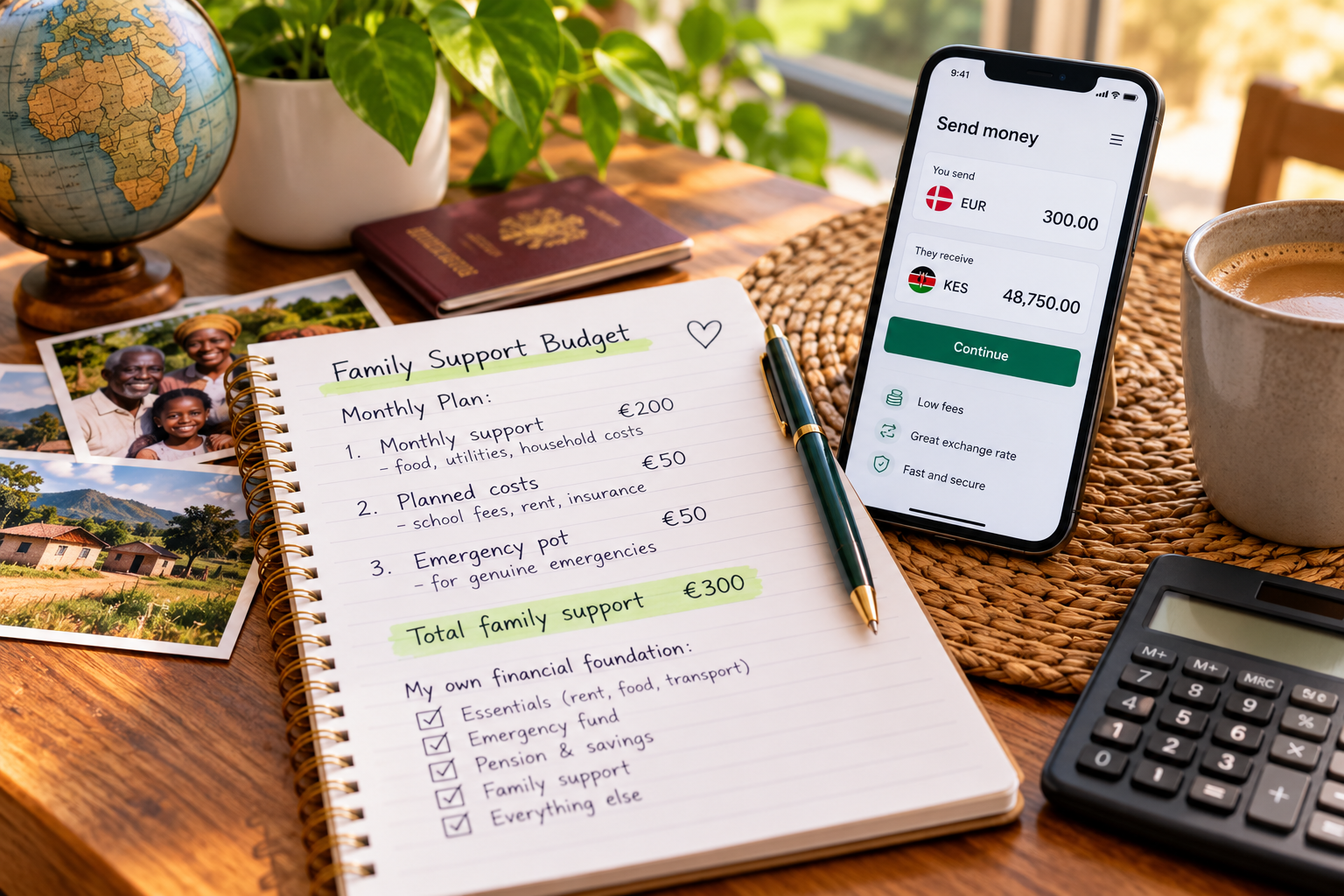
Budgeting a monthly amount to send home to family

How Much Should I Send Home? A Simple Monthly Budget for Family Support

By Martha Muigai · Smart Money Diaspora · Part of the Black Tax series · 6-minute read

It’s one of the most common questions I hear from people living abroad:

“How much should I actually be sending home?”

Usually it’s asked quietly, with a bit of guilt. Because for most of us, the honest answer has been: whatever was asked, whenever it was asked. A message arrives, we send. Another arrives, we send again. And at the end of the month we wonder where our savings went.

In my guide to black tax, I explained why supporting family is part of who we are, and why doing it without a plan can hurt both you and them. This post is the practical part: a simple, four-step way to decide how much to send each month, and how to stick to it without guilt.

Key Takeaways

  • Start with your family’s real monthly gap, not with what’s asked.
  • The gap is not automatically yours alone to fill. Share it.
  • Decide what you can sustain without weakening your own financial foundation.
  • Split the amount into three buckets: monthly support, planned costs, and an emergency pot.
  • Send on a fixed day, pay big bills directly, and review once a year.

Step 1: Find Your Family’s Real Monthly Gap

Before you decide what to send, find out what’s actually needed. Call your family (or whoever manages the household) and fill in a simple worksheet together:

Monthly household cost Amount (local currency)
Food and household items
Rent or housing
Electricity, water, gas
Medical costs and medication
Transport
School costs (spread per month)
Total monthly costs
Minus income they already have (pension, work, rent, farming, other relatives)
= The real monthly gap

That last line is your starting point. Not the loudest request. Not the biggest emergency. The gap.

Two things usually happen when families do this for the first time:

  • The gap is smaller than expected, because planned spending is cheaper than emergency spending, and some costs were being covered twice.
  • Or it’s bigger than expected, and it becomes clear that one person can’t cover it alone. That’s just as valuable to know.

Either way, you’re now working with facts rather than feelings.

Don’t Confuse the Family Gap With Your Responsibility

Here’s the part many of us miss: the family gap is not automatically one person’s responsibility.

Just because you’re the one abroad doesn’t mean the whole gap lands on you. Say the family’s monthly gap is €500. It could be covered like this:

Who contributes Monthly
You €200
A sibling €150
Another relative €100
Extra family income (e.g. selling produce) €50
Total gap covered €500

When you see the gap written down, it becomes much easier to have an honest family conversation about who can contribute what, instead of everyone quietly assuming the person abroad will cover it all.

Step 2: Decide What You Can Sustainably Afford

Now turn to your own budget. The question isn’t “How much can I send this month?” It’s “How much can I keep sending, every month, for years?”

Look at your own monthly budget and cover these first:

  1. Your essentials: rent, food, transport, childcare, insurance, debt repayments.
  2. Your emergency fund: a buffer for your own household.
  3. Your pension and savings: even a small, regular amount.

What’s left after these is your monthly surplus, and that’s where sustainable family support comes from.

This doesn’t mean your family always comes last. Someone supporting an elderly parent with no other income is in a very different position from someone sending money for extras. Sometimes support is essential, and you’ll choose to save less for a while. The principle is simply this:

Protect your financial foundation before you commit to a level of family support you can’t sustain.

If you lose your job with no savings, two households are in trouble instead of one. Protecting yourself protects them.

Your situation Starting point
New abroad, still building your emergency fund A small fixed amount you can sustain
Settled, emergency fund in place An amount that fits your monthly surplus
Established, strong savings and fewer competing obligations A larger amount may be sustainable
Sharing support with siblings or relatives Your agreed share of the actual family gap

There is no universal percentage that every immigrant should send home. The right amount depends on your income, essential expenses, debt, savings, dependants and the actual gap in your family. Don’t send based on what’s asked. Send based on what’s actually needed and what you can sustainably afford.

Step 3: Split It Into Three Buckets

A single lump sum gets spent on whatever is most urgent that week. Splitting your family-support budget into three buckets makes it go much further:

  1. Monthly allowance: sent on a fixed day for everyday living costs.
  2. Planned big costs: school fees, rent due annually, insurance. Saved monthly and paid when due.
  3. Family emergency pot: kept in your account and used only for genuine emergencies.

YOUR FAMILY SUPPORT BUDGET: €300 / month

Bucket Monthly How it’s used
Monthly allowance €200 Sent on the 1st for food, utilities and household costs
School fees fund €50 Saved monthly, paid directly to the school each term
Emergency pot €50 Stays in your account; builds to €600 a year
Total €300 Illustrative family-support budget

The emergency pot is the bucket that changes everything, but only if you use it correctly. The emergency pot is not a second monthly allowance. It’s a separate reserve for genuine, unexpected expenses: urgent medical treatment, a funeral, a serious repair that can’t wait. It isn’t for things that could have been planned, and it isn’t a fund that can be spent whenever someone asks.

Used this way, it protects everyone. When a real emergency arrives, you’re not choosing between your family and your own rent. You check the pot. And if a request isn’t a genuine emergency, or the pot is empty, you have an honest answer ready: “Let’s plan for this next month.”

Step 4: Make It Run Smoothly

  • Send on a fixed day. The same date every month. Your family can plan around it, and you stop getting “is it coming?” messages.
  • Automate it if your transfer provider allows scheduled payments.
  • Compare transfer providers. Fees and exchange-rate margins vary a lot, and a few percent lost on every transfer adds up over a year.
  • Pay big bills directly. Send school fees to the school and hospital bills to the hospital. It’s transparent and removes any pressure on whoever receives the money.
  • Share the load. If siblings or relatives also earn, agree who covers what. One takes school fees, another covers groceries, another handles medical costs.
  • Review once a year, or when your income or their situation changes. A pay rise can mean a little more support; a new baby or job loss on your side can mean a little less.

What to Say When You’re Asked for More

This is the hardest part. A few phrases that keep the door open without breaking your budget:

  • “I’ve already sent this month’s support. Can we plan this for next month?”
  • “Let me check the emergency pot and I’ll come back to you.”
  • “I can’t cover all of it, but I can contribute this much. Can someone else help with the rest?”
  • “I want to keep supporting you for years, not just this month. That’s why I stick to the plan.”

Saying no to one request isn’t saying no to your family. It’s saying yes to being able to help them next year, and the year after.

Frequently Asked Questions

What percentage of my salary should I send home? There’s no universal percentage. The right amount depends on your income, essential costs, debt, savings, dependants and your family’s actual monthly gap. Start with a fixed amount that fits your monthly surplus after your essentials and emergency fund, and review it once a year.

Should I send money home before building my own emergency fund? Send a smaller, fixed amount while you build your emergency fund, then increase it once you have a buffer. Without savings, one job loss puts both households at risk.

How do I handle emergencies if I send a fixed amount? Keep a separate family emergency pot in your own account, topped up monthly. Use it only for genuine emergencies like medical costs, and plan anything else for the following month.

What’s the cheapest way to send money home? Compare providers on both the fee and the exchange rate, since a poor rate can cost more than the fee. Check a few options before every large transfer.

One Plan, Many Years of Support

Sending money home is an act of love. A budget doesn’t take the love out of it. It makes sure you can keep giving, steadily and without resentment, for as long as your family needs you.

And once your monthly budget is in place, the next step is making it lighter: turning part of that support into assets that pay for themselves. I share how I approached this with our family home in Black Tax: What It Is, Why It Exists and How to Make It Sustainable.

Build Wealth. Create Choices. Leave a Legacy.

Get Your Free Diaspora Wealth Checklist

Family support is one of seven areas in my free checklist:

Income → Spending → Emergency Fund → Family Support → Savings → Investments → Wealth Goals

Use it alongside this budget to see how family support fits into your whole financial picture.

👉 Get the Free Diaspora Wealth Checklist

💬 Over to you: do you send a fixed amount home, or do you respond to requests as they come? What’s worked for your family? Tell me in the comments.

Keep reading:

Black Tax: What It Is, Why It Exists and How to Make It Sustainable

 Martha Muigai · Smart Money Diaspora · Part 1 of the Black Tax Series

Supporting family is part of who we are. Doing it without a plan doesn’t have to be.

It usually starts with a message.

“Hope you’re well. Mum’s medicine has run out.” Then another: “The school fees are due on Friday.” And sometimes: “The roof is leaking again.”

If you’re part of the diaspora, you know these messages. You also know the feeling that comes with them: love, duty, guilt and, at times, a quiet panic as you check your balance.

Many of us have a name for this. We call it black tax.

I’ve paid it, and I still pay it. Even so, I don’t believe the answer is to stop. Instead, after years of supporting family from abroad, I’ve learned that how you support your family matters as much as how much. Support without a plan can drain you for decades and still leave your family in the same place. Support with a plan, on the other hand, can make your family more secure and free you to build your own future too.

THE BLACK TAX SERIES

Part 1: Understand Black Tax (you’re here)

Part 2: Create a Family Support Budget

Part 3: Turn a Family Asset Into Income

Part 4: Build Capital That Produces Family Income

Key Takeaways

  • Black tax is the financial support you’re expected to give family once you “make it”, especially when you earn more or live abroad.
  • It exists because of income gaps, missing safety nets and a culture of shared responsibility, not because anyone is greedy.
  • Left unplanned, it can leave both you and your family without security.
  • A sustainable approach moves step by step: understand the need, budget for it, share it, and build assets that help carry the cost.

What Is Black Tax?

Black tax is the money, time and resources that a person who has become financially better off is expected to give to their parents, siblings and extended family.

The term became popular in South Africa, where it describes the pressure on Black professionals, often the first in their family to go to university or earn a steady salary, to support the people who helped them get there. In 2019, the book Black Tax: Burden or Ubuntu?, edited by Niq Mhlongo, brought the debate into the mainstream.

Today, the phrase is used far beyond South Africa, across Africa, the Caribbean and the wider diaspora. In fact, the experience isn’t limited to one race or region at all. Many immigrant families from Asia, Latin America and the Middle East know it well, even if they call it something else.

In practice, black tax can look like:

  • School or university fees for siblings, nieces and nephews
  • Parents’ rent, food, utilities and medical bills
  • Contributions to weddings, funerals and community fundraisers
  • Building or repairing the family home
  • Loans that are rarely paid back
  • Being the answer to every family emergency

It’s called a tax because it can feel compulsory. However, unlike a real tax, there’s no rate, no ceiling and no end date, unless you create one.

Why Does Black Tax Exist?

It’s easy to describe black tax as families being demanding. That isn’t fair, and it isn’t accurate either. Black tax exists for real, structural reasons.

Historical inequality. Colonialism, apartheid and decades of economic exclusion meant many families never had the chance to build wealth that could be passed down. When there’s no inheritance and no family savings to fall back on, the first person to earn a good income naturally becomes the safety net.

Missing safety nets. Here in Denmark, the state covers much of what families elsewhere cover themselves: pensions, healthcare, unemployment support and education. In many of our home countries, however, those systems are limited or unreliable. As a result, the family is the pension, the health insurance and the unemployment benefit.

The income gap. When you earn in euros, pounds or dollars and your family earns in a currency worth a fraction of that, even a small share of your salary can change their month. Because of that gap, the expectation feels natural on both sides.

Sacrifice and gratitude. Many of us are where we are because someone sold land, took a loan or went without so we could study or travel. For that reason, supporting them isn’t only duty. It’s gratitude.

Ubuntu. “I am because we are.” In many cultures, success is shared. Your achievement belongs to the family, and sharing it is part of who you are.

So black tax isn’t simply a burden. It’s also love, loyalty and community. The problem isn’t that it exists. The problem is when it’s unplanned, unlimited and never builds anything lasting.

The Hidden Cost of Unplanned Black Tax

When support has no plan, it quietly costs you, and often your family too.

  • You never build your own safety net. Without an emergency fund, a pension or investments, one job loss puts two households in trouble.
  • Nothing grows. Money that only covers this month’s needs has to be sent again next month.
  • The cycle repeats. If you reach retirement with nothing, your own children may end up paying black tax for you.
  • Relationships get strained. Resentment builds on one side, while uncertainty builds on the other.
  • You burn out. Many of us carry this silently, and over time it weighs on our health and peace of mind.

In other words, the goal isn’t to stop helping. Rather, it’s to help in a way that you can keep up for years, and that leaves your family stronger over time.


A Better Way: Four Steps to Sustainable Support

Over the years, I’ve come to see sustainable family support as a journey with four stages. Each part of this series covers one of them in depth.

Step 1: Understand the real need

First, find out what your family actually needs each month. List their costs, subtract any income they already have, and you’ll see the real gap. Often it’s smaller than the total of all the ad-hoc requests. Sometimes it’s bigger than you realised, which is just as important to know.

Step 2: Budget for it, and share it

Next, decide what you can sustainably contribute after protecting your own foundation. Then make it a fixed line in your budget, keep a separate emergency pot, and agree with siblings and relatives who covers what. After all, the gap isn’t automatically one person’s responsibility. I walk through this step by step in How Much Should I Send Home?

Step 3: Turn a family asset into income

Where your family has land, a home or skills, look for ways to make them productive. For example, livestock, a small rental or a small business can produce income that covers part of the need. I share how I did this with our family home in part 3.

Step 4: Build capital that produces income

Finally, build a pot of capital and invest it, so your family lives on the income while the capital stays intact. Over time, the asset takes over more of the support, and you stop being the only source. I explain how in Spend the Income, Keep the Capital.

Don’t just send money. Build something that keeps sending it for you.

Other Ways to Lighten the Load

Alongside those four steps, a few simple habits make support go further:

  • Invest in education and skills. Paying for a course or diploma is support with an end date, and it creates another earner in the family.
  • Consider health insurance. One hospital stay can wipe out months of support, whereas a policy turns an unpredictable emergency into a predictable premium.
  • Create a family fund. Borrowing the idea of a savings group (a chama, susu, tontine or stokvel), family members at home and abroad can contribute monthly into one pot for emergencies and big projects.
  • Pay providers directly. Sending school fees to the school and hospital bills to the hospital keeps things transparent for everyone.
  • Set time limits on short-term help. “I’ll cover rent for three months while you find work” is kinder and clearer than an open-ended promise.
  • Protect yourself too. If people depend on you, keep life insurance and keep building your own pension.

My Story: Two Things I Did Differently

I want to share two decisions from my own family, because they show that black tax doesn’t have to be a bill you pay forever. Instead, it can be something you build.

I helped another family member move abroad, so we share the load

For a long time, I was the one abroad, which meant I was the one people turned to. So instead of carrying it alone, I encouraged and sponsored another family member to move abroad too.

It was an investment, and not a small one. Even so, it did two things at once. First, it changed their life, giving them access to better income and a future they’re building for themselves. Second, it lightened the weight on my shoulders, because we now share the family responsibilities between us.

This is what I mean by making black tax beneficial. The money didn’t disappear into one month’s expenses. It created a second earner, and a better life for someone I love.

I turned our family home into an income-producing farm

After my parents passed away, our family home stood mostly abandoned for years. My brother stepped in to care for it, and when he passed away in 2024, I promised myself the home would never be abandoned again.

Rather than sending money every month to maintain it, I started small, with one dairy cow and four sheep, and employed someone to look after the animals and the home. Today, milk is sold, the flock has grown, and that income helps maintain the home and pay the caretaker. I tell the full story in part 3 of this series.

The lesson: before you send money for the same need again and again, ask, “Is there an asset that could help cover this need by itself?”

How to Talk to Your Family About Black Tax

None of this works without an honest conversation, and that’s often the hardest part. These approaches help:

  • Lead with love, not limits. “I want to keep supporting you for the long term, so let’s plan it together.”
  • Share the plan, not just the number. Explain the monthly amount, the emergency pot and the bigger goal.
  • Be honest about your own costs. Many families don’t realise how expensive life abroad is. I wrote about this in The Lie That Moving Abroad Automatically Means Financial Success.
  • Involve them in the solution. People take better care of a business or a herd when it’s theirs to grow.
  • Hold steady. Changing a long-standing pattern takes time, and consistency builds trust.

Frequently Asked Questions

What does black tax mean? Black tax is the financial support that people who become better off, often the first in their family to earn a good income or move abroad, are expected to provide to parents, siblings and extended family.

Is black tax bad? Not in itself. It comes from love, gratitude and a culture of shared responsibility. However, it becomes harmful when it’s unplanned and unlimited, leaving the giver with no savings and the family no more secure.

How much should I send home each month? There’s no universal percentage. The right amount depends on your income, essential costs, savings, dependants and your family’s actual monthly gap. Part 2 of this series shows you how to work it out.

How can I make black tax sustainable? Understand the real need, budget a fixed amount, share the load with others, and gradually build assets, such as livestock, a small business or an investment, that help carry the cost.


Turn Black Tax Into a Legacy

Supporting our families is part of who we are, and I don’t want anyone to stop.

But I do want us to stop paying the same bill forever. When you budget for black tax, share it and slowly turn it into assets, something changes. Your family becomes more secure. Meanwhile, you get the space to build your own future. And eventually, the next generation may never have to pay it at all.

That’s how black tax becomes a legacy.

Build Wealth. Create Choices. Leave a Legacy.


Ready to Make a Plan?

Family support is one of seven areas in my Free Diaspora Wealth Checklist:

Income → Spending → Emergency Fund → Family Support → Savings → Investments → Wealth Goals

Use it to see where family support fits in your whole financial picture.

👉 Get the Free Diaspora Wealth Checklist

💬 Over to you: how do you handle black tax in your family? Have you found a way to turn support into something that pays for itself? Share it in the comments. Your idea could help someone else.

Continue the series: Part 2: How Much Should I Send Home? A Simple Monthly Budget for Family Support →

New here? Begin with Start Here.

This article is for general education and isn’t personal financial advice

Immigrant woman working on a laptop while travelling, representing financial planning and building wealth abroad

What I Wish I Knew About Money Before Moving Abroad: 12 Lessons for Immigrants

By Martha · Smart Money Diaspora · 10-minute read

Moving abroad can feel like the beginning of a better financial life. You imagine earning more, supporting your parents and family back home, saving, investing, buying property, and finally having the security that may have felt out of reach before.

I understand that feeling.

I came to Denmark as an immigrant, and like many people who leave their home country, I carried more than a suitcase. I carried expectations. I wanted to build a better life, become financially secure and create opportunities that might not have been possible if I had stayed.

But there were things I didn’t understand about money when I first arrived:

  • I understood that I would earn more. I didn’t understand what it would cost to build a life.
  • I understood that I could send money home. I didn’t understand how easily family responsibilities could compete with my own financial future.
  • I understood that earning more should make me wealthier. I didn’t yet understand that income, cash flow and wealth are three completely different things.

And the biggest lesson of all:

Moving abroad can increase your income without increasing your wealth.

Whether you’re preparing to move, have just arrived, or have been abroad for years and still feel like you’re running in place financially, these are the 12 lessons I wish someone had explained to me.

Key Takeaways

  • A higher salary abroad is an opportunity to build wealth, not a guarantee of it.
  • Budget in the currency you live in, not the one you left behind.
  • As an immigrant you manage two financial worlds: the life you’re building abroad and your responsibilities back home.
  • Give family support a budget and a boundary.
  • Build an emergency fund before taking investment risk, especially back home.
  • Your career and earning power are among your biggest financial assets.

The Money Reality of Moving Abroad

When you come from a country where salaries are lower, a salary in Europe, North America or another high-income country looks enormous. You convert it into your home currency and think: “I’m going to make so much money.”

Then you arrive, and reality begins.

Rent is higher. Taxes take a significant share of your income. Transport, groceries and insurance all cost money. Childcare can be expensive. You need winter clothes, furniture and everything else it takes to get established.

And then there’s the other side of your financial life: the people and responsibilities you left behind. Someone needs help with school fees. A parent needs medical treatment. A sibling needs money. The family expects you to contribute to a building project. Someone wants you to invest in land.

Suddenly, the salary that looked enormous on paper doesn’t feel so enormous anymore. This is where many immigrants discover an uncomfortable truth:

A higher income creates an opportunity to build wealth. It does not automatically create wealth. (I dig deeper into this in The Lie That Moving Abroad Automatically Means Financial Success.)

1. A Higher Salary Doesn’t Automatically Make You Wealthy

This was one of the most important lessons for me.

Moving to a higher-income country can dramatically increase your salary, but your cost of living changes too. You may now be paying for rent or a mortgage, utilities, transport, food, insurance, taxes, childcare, clothing, holidays, debt repayments, family support and the unexpected bills that always arrive.

You can earn more than you ever imagined and still have very little left at the end of the month. That’s why I now think about three different things:

Term What it means Why it matters
Income What you earn Your starting point
Cash flow What remains after money comes in and goes out Decides what you can save and invest
Wealth What you accumulate and own over time What you’re actually building

The question isn’t simply “How much do I earn?” It’s:

“How much of what I earn am I converting into financial security and assets?”

That distinction changed the way I think about money.

2. Stop Measuring Your Salary in the Currency You Left Behind

This is one of the easiest mistakes to make. Your first salary arrives and you immediately convert it into Kenyan shillings, Nigerian naira, Ghanaian cedi, Indian rupees or whatever currency you grew up with. The number looks enormous. You feel rich.

But you don’t live in that currency. Your rent isn’t paid in shillings. Your electricity bill isn’t paid in naira. Your groceries aren’t priced in cedi. Your pension contributions aren’t calculated in your home currency. Your daily financial reality is set by the country where you live.

Conversion is useful when you send money home or compare an investment across borders. It should never set your lifestyle.

A large number in your home currency doesn’t necessarily mean a high standard of living where you live. Learn the purchasing power of your money in the country you actually call home now.

3. Moving Abroad Costs More Than You Think

Before moving, most people think about the salary. Far fewer calculate the cost of becoming established:

  • Visa and documentation
  • Flights and temporary accommodation
  • Rental deposits and furniture
  • Transport and professional fees
  • Clothing for a completely different climate
  • Setting up your home
  • Helping family financially while you’re still getting on your feet

Your first months abroad can be some of the most expensive of your life, and you’re paying for them while learning an entirely new system. You may not yet understand the tax system, the pension system, which insurance you need, how credit works, or where to invest.

You’re learning how to live in a new country and how to manage money in it at the same time. Looking back, I would have put far more emphasis on preparing before I moved. Not just “How much will I earn?” but “How much will it cost me to establish my life?”

If you’re still planning your move, read Top 10 Financial Mistakes to Avoid When Moving Abroad next.

4. Your Family Back Home Is Part of Your Financial Reality

This is where diaspora finances become different from ordinary personal finance.

Read: Black Tax — How to Make Family Support Sustainable →

When you move abroad, you don’t leave your financial responsibilities behind. Sometimes they grow. For many immigrants, there are effectively two financial worlds: the life you’re building abroad, and the family, property, obligations and expectations connected to home.

  • You may be paying your own rent while contributing to your parents’ household.
  • You may be saving for your child’s future while paying your sibling’s school fees.
  • You may be building an emergency fund while someone back home needs medical treatment.
  • You may be paying a mortgage abroad while financing construction on a house back home.

This isn’t necessarily a problem. Helping family is part of who we are, and for many of us it’s an important value. The problem is when support becomes unlimited.

At some point, you have to recognise that your own financial future is also a responsibility. You still need emergency savings, retirement savings, insurance, investments, housing, security for your children and your own long-term goals.

I learned to think about family support as something that needs a budget and a boundary:

  • Set a fixed monthly amount for family support and treat it like rent: planned, not leftover.
  • Keep a separate small pot for true emergencies, so not every request becomes one.
  • Pay school fees or hospital bills directly where you can.
  • Compare transfer providers so fees and poor exchange rates don’t quietly eat what you send.

There’s a difference between supporting your family and becoming financially responsible for everyone. That distinction can protect your future without asking you to stop caring about the people you love.

5. Lifestyle Inflation Can Eat Your Financial Progress

When your income rises, your lifestyle usually wants to rise with it: a nicer apartment, a better car, more travel, more eating out, a new phone.

And when you’ve moved abroad, there’s another pressure: you want people back home to see that the move was worth it. That’s where things get dangerous, because you can feel pressure to look successful before you’ve actually become financially secure.

None of these things are bad on their own. The problem is when your lifestyle grows at exactly the same speed as your income. Get an extra €500 a month and spend all €500, and your income has risen but your financial position hasn’t.

Instead, split every raise between:

Enjoyment + savings + investments + future goals.

You’re allowed to enjoy your money. Just don’t let your lifestyle consume every opportunity you create.

6. Build an Emergency Fund Before You Take Investment Risk

When you finally start earning more, investing feels exciting. You hear about stocks, property, businesses, crypto and funds. People back home may tell you about the next “great opportunity.”

But before you build wealth, you need stability. What happens if you lose your job, and your residence permit depends on it? If you suddenly need to fly home? If the car breaks down or an unexpected bill lands? Without a buffer, you may be forced to borrow or sell investments at exactly the wrong time.

For many people, a sensible sequence is:

Income → Emergency fund → Debt management → Investing → Wealth building

The exact order depends on your circumstances, but the principle holds: don’t build an investment portfolio with no financial foundation underneath it. My Financial Foundations section walks you through setting this up.

📥 Not sure where you stand? My free Diaspora Wealth Checklist takes you from income to wealth goals in one page.

7. Learn the Financial System of the Country You Live In

One of the best investments you can make after moving abroad is learning how money works in your new country. You don’t need to become a tax lawyer or investment professional, but you should understand the basics:

  • Income tax and capital gains tax
  • Pensions, social security and retirement savings
  • Healthcare and insurance
  • Housing, mortgages and consumer credit
  • Investment accounts
  • Benefits and allowances
  • Rules for transferring money internationally

I’ve lived in Denmark long enough to know that the financial system here is very different from the systems many immigrants grew up with. And that’s something every immigrant needs to appreciate:

You’re not simply earning money in a new country. You’re operating inside a new financial system.

Learn the rules. The better you understand the system, the better decisions you can make within it. New to all this? Begin with my Start Here guide to financial literacy for immigrants.

8. Don’t Wait Until You’re “Rich” to Start Investing

Many people believe investing is something you do once you’re financially comfortable. But when exactly do you become comfortable? There’s always another expense, another family responsibility, another holiday, another reason to wait.

The better question is: “Have I built enough stability to start investing consistently?”

Investing doesn’t have to start with a huge amount. What matters is building the habit of owning assets, so investing becomes part of your financial system rather than something you do only when there’s “extra money.”

That shift matters. Instead of only asking “How can I earn more?”, you start asking “How can I turn part of my income into assets?” That’s where the move from earning to wealth building begins. Explore the Save & Invest section for beginner-friendly guides.

9. Be Careful When Investing Back Home

This is a particularly important lesson for immigrants.

Investing back home feels emotionally attractive. You know the country and the culture. You may have family there. Land or property can feel safer because you can physically see it. And there’s often a strong belief that “I need to build something back home.”

But familiarity doesn’t automatically make an investment good. Before you buy land, build a house or purchase an apartment back home, ask:

  • What is the total cost, including financing?
  • What income will it generate, and what will maintenance and taxes cost?
  • What happens if it sits vacant?
  • How easy would it be to sell?
  • What else could this money be doing?
  • Am I buying because the numbers make sense, or because owning property makes me feel successful?

Distance creates one more issue: management. When you’re thousands of kilometres away, who is checking the property, collecting rent, handling repairs, and making sure the title documents are in order? An asset you can’t manage effectively can quickly become a financial burden.

10. Looking Successful Abroad Isn’t the Same as Being Financially Secure

This is one of the hardest lessons, because success is so often measured visually.

People see the car, the house, the holiday, the clothes, the property back home and the photos on social media. They don’t see the debt, the overdraft, the empty emergency fund, or how much of the salary goes into maintaining the image.

Real financial security is often boring and invisible: your pension, your investment account, your emergency fund, your low debt, your financial plan. Someone can look extremely successful and be financially fragile. Someone else can look completely ordinary and have substantial assets.

That’s why I no longer think the goal should be to look successful abroad. The goal should be to become financially secure abroad. (More on the mindsets behind this in 5 Mindsets You’re Likely to Find Among Immigrants Abroad.)

11. Your First Years Abroad Should Be About Building a Foundation

There can be enormous pressure to achieve everything at once: buy property, send money home, build a house, buy a car, start a business, invest, travel, support relatives, get married, have children, and look successful while you do it.

You don’t have to.

Your first years can be about learning the country and its financial system, building your career, growing your income, controlling expenses, building an emergency fund and understanding investing. Then you gradually take on more.

You don’t have to prove that moving abroad was worth it in your first two years. You’re building a life, and that takes time.

12. Your Earning Power Is One of Your Biggest Financial Assets

Saving matters, but there’s a limit to how much you can cut. Your earning potential can grow much further.

When you move abroad, your career becomes one of your most important financial investments:

  • Learn the local language
  • Get your qualifications recognised
  • Understand the labour market and build valuable skills
  • Change employers when it makes sense, and negotiate your salary
  • Move into a higher-paying profession
  • Build a business or a second income stream

For me, this is one of the biggest mindset shifts: your career is not just your job. It’s an asset. And the more you earn without letting your lifestyle consume it all, the more capital you have to build wealth.

What I Would Do Differently If I Were Moving Abroad Today

If I were starting again, I’d plan my financial life before I packed my suitcase, covering seven areas:

  1. Calculate the real cost of relocation. Not just the visa and flight, but the deposit, accommodation, transport, furniture, clothing and food it takes to get established.
  2. Plan my first six months. How much do I need before I’m realistically settled?
  3. Establish an emergency fund. One of my very first priorities.
  4. Create a family-support budget. What I can sustainably send home without sacrificing my own future.
  5. Learn the financial system. The tax, pension, savings and investment rules, before investing, buying property or taking on debt.
  6. Decide how I want to build wealth. A deliberate strategy for turning income into assets, instead of saving whatever is left.
  7. Think beyond the next five years. Where do I want to be financially in 10, 20 and 30 years? That question changes the decisions you make today.

The Diaspora Wealth Question

There’s one question I wish more immigrants asked. Not “How much can I send home?” Not “When can I buy property?” Not “How much do people think I’m earning?”

But:

“How can I use the opportunity of living abroad to create lasting wealth?”

That question changes everything. It makes you think beyond your next salary, about your pension, your investments, your children’s future, your family responsibilities, your career, your independence and, eventually, your legacy.

Living abroad can give you access to opportunities. But opportunity is not the same thing as wealth. You have to build the bridge between the two.

Your Diaspora Money Checklist

Before your next major financial decision abroad, ask yourself:

  • ☐ Am I increasing my income, or actually increasing my wealth?
  • ☐ Do I know where my money goes every month?
  • ☐ Am I budgeting according to the country where I live?
  • ☐ Do I have an emergency fund?
  • ☐ Am I supporting family within a sustainable budget?
  • ☐ Is my lifestyle growing faster than my wealth?
  • ☐ Do I understand the financial system where I live?
  • ☐ Am I investing consistently?
  • ☐ Am I building assets rather than only earning income?
  • ☐ Do I understand the risks of investing back home while living abroad?
  • ☐ Am I deciding because it makes sense, or because I want to look successful?
  • ☐ What will this decision mean for me five or ten years from now?

You don’t need every answer today. But you do need to start asking better questions.

Frequently Asked Questions

How much money should I save before moving abroad? Enough to cover relocation costs plus several months of living expenses in your new country, priced in the local currency. Include rental deposits, furniture and winter clothing, which newcomers often underestimate.

How much should I send home to family? There’s no single right number. Decide on a fixed monthly amount you can sustain after covering your own essentials, emergency fund and savings, and treat it as a planned budget line rather than whatever is left over.

Should I build an emergency fund or invest first? Build the emergency fund first. If your residence permit depends on your job, or you might need to fly home at short notice, a buffer keeps you from borrowing or selling investments at a bad time.

Is buying land or property back home a good investment? It can be, but only if the numbers work. Look at the total cost, expected income, maintenance, taxes, vacancy risk and how easily you could sell, and plan who will manage it while you live abroad.

Start Building Your Diaspora Wealth Plan

Moving abroad can change your financial life. It can open the door to higher incomes, stronger financial systems and investment possibilities that may not have been available to you before.

But a higher income is only the beginning. You still have to decide what to do with it.

You can earn more and remain financially stretched. You can support everyone else and neglect your own future. You can buy property and have little cash available. You can look successful while carrying significant debt.

Or you can gradually turn your income into savings, investments, assets and, ultimately, choices:

  • The choice to leave a job that no longer serves you
  • The choice to help your family without putting your own future at risk
  • The choice to give your children opportunities you never had
  • The choice to return home, or stay abroad, because you want to, not because your finances force you
  • And eventually, the choice to leave something meaningful behind

That’s what wealth ultimately gives you: choices. So the goal of moving abroad shouldn’t simply be to earn more money. It should be to build a stronger foundation, create lasting wealth and give yourself, and the next generation, more choices.

Build Wealth. Create Choices. Leave a Legacy.

Ready to Take Control of Your Money Abroad?

I created the Free Diaspora Wealth Checklist to help you think systematically about your finances as an immigrant. In one page, you’ll review your:

Income → Spending → Emergency Fund → Family Support → Savings → Investments → Wealth Goals

Don’t wait until you feel financially secure to start planning. Start where you are. Build from there.

👉 Get the Free Diaspora Wealth Checklist

💬 Over to you: which of these 12 lessons hit closest to home? Tell me in the comments. I read every one, and your answers shape what I write next. And if you know someone planning a move abroad, share this with them.

Just beginning your journey? Follow the path: Start Here → Financial Foundations → Save & Invest → Global Wealth & Legacy

Because building wealth abroad isn’t one decision. It’s a journey.

Top 10 Financial Mistakes to Avoid When Moving Abroad

Moving abroad can be one of the biggest financial opportunities of your life. But it’s also where some of the most common financial mistakes moving abroad happen. These mistakes are expensive. Some are hard to reverse.

A new country can offer better career opportunities, higher income, and access to new financial systems. It can open the door to real wealth. But without the right knowledge, that opportunity can quietly slip away.

I know this journey personally. More than twenty years ago, I moved abroad as an au pair. Later, I became an international student and worked while studying. I built my career in finance and accounting. I started a family, and eventually began thinking seriously about wealth creation.

Looking back, I’ve learned that moving abroad isn’t simply about earning more money. It’s about understanding the financial system you’re entering and making intentional decisions from the start.

The Most Common Financial Mistakes Moving Abroad

You might be planning your move. You might have just arrived, or lived abroad for years already. Either way, here are the ten financial mistakes most worth avoiding, and what to do instead.

1. Assuming a Higher Salary Automatically Means a Better Financial Life

One of the biggest mistakes people make when moving abroad is looking only at the salary. You might hear that someone earns €50,000, £60,000, or $80,000 and assume they’re financially comfortable. But salary is only one part of the picture.

Before you get excited about a number, look at the full cost side too. That means taxes, housing, transportation, health insurance, and childcare. It means food, everyday expenses, and pension contributions. It means debt repayments, support for family back home, and currency exchange costs. A higher salary in a country with a much higher cost of living doesn’t automatically mean more disposable income.

Before accepting a job abroad, calculate your expected net income after taxes and essential expenses. Use real numbers from cost-of-living comparisons and local expat communities, not assumptions carried over from home. The question isn’t how much will I earn? The better question is how much will I actually have left after living expenses? That number gives you a much clearer picture of your real financial opportunity.

2. Moving Without Understanding the Tax and Banking System

Taxes create some of the most expensive surprises for immigrants. Not knowing the rules until they cost you is one of the costliest financial mistakes moving abroad can involve. Your tax obligations depend on your country of residence, your citizenship, your income source, your investments, and your property. Some countries also have tax treaties that change how they tax income across borders. Official UK guidance on tax if you leave the UK to live abroad walks through the rules. It covers residency, taxation, and double taxation arrangements.

If you’re moving abroad, don’t assume your tax situation will be simple. Find out when you become tax resident. Learn how your new country taxes employment income and investment income, and how it treats foreign income. Check whether your home country still holds obligations over you. Check whether a tax treaty applies, and whether you need to report foreign assets or accounts.

Everyday banking habits quietly cost people money too. Using your home bank card for daily spending abroad often means paying foreign transaction fees. It usually means a weak exchange rate too, and those costs add up without you noticing. Your home country’s credit history usually doesn’t transfer with you either. Many newcomers start from zero. They can’t get a phone contract or credit card until they build a local track record. Open a local bank account as soon as you’re eligible. Ask locals or expat groups how credit works where you live now. Start building a footprint early through a local phone plan, a small local card, or on-time rent payments.

If your tax situation is complicated, talk to a qualified cross-border tax professional. A few hours of advice can save you years of expensive mistakes.

3. Failing to Build an Emergency Fund

Moving abroad can make unexpected expenses much more stressful. You may lose your job. Your rent may increase. You may need to travel home unexpectedly. Your family may need financial help. You may face an emergency your normal monthly budget simply can’t absorb. Without savings, an unexpected expense can quickly become debt. A medical emergency without the right health coverage can undo years of progress in a single bill. So confirm exactly what your visa or residency requires before you need it.

Before you focus heavily on investing, build a financial safety net. A reasonable starting goal covers several months of essential expenses. The exact amount depends on your employment stability, your family responsibilities, and what other resources you can access. Where that money sits matters too. Say your emergency fund sits in a home-country account you can’t easily reach. Or it sits entirely in a currency that’s sliding against your local one. Either way, it won’t help you the moment you actually need it. Keep at least part of it accessible in your country of residence, in the local currency.

Your emergency fund isn’t meant to make you rich. It exists to keep one unexpected event from destroying your financial progress.

4. Sending Money Home Without Understanding the True Cost

For many immigrants, supporting family back home is an important part of life abroad. But regularly sending money internationally can become a significant expense. One mistake is looking only at the advertised transfer fee. A transfer that calls itself “free” may still cost you through the exchange rate margin, currency conversion, or withdrawal fees. The Consumer Financial Protection Bureau’s guidance on money transfers warns people to check the total cost. That means the fees, the exchange rate, any taxes, and the amount the recipient actually receives.

Before sending money, compare the amount you pay against the amount your family actually receives. Check that figure against a specialized international transfer service, not just your regular bank’s rate. That comparison tells you far more than comparing advertised fees alone. Even a small percentage difference adds up significantly if you send money regularly over several years.

5. Supporting Everyone Before Building Your Own Financial Foundation

This is a sensitive subject for many immigrants. You may move abroad wanting to help your parents, siblings, children, relatives, or community. That generosity can be admirable. But there’s a real danger in trying to solve everyone else’s financial problems while neglecting your own.

Say you have no emergency fund, no retirement savings, no investments, and significant debt. Sending money home continuously may leave you financially vulnerable. Think of your financial life as a foundation. You need enough stability for yourself before you can sustainably support others. Supporting family and building your own future don’t have to compete. The key is setting boundaries and making a plan. Then ask yourself honestly how much you can send without damaging your own future.

6. Increasing Your Lifestyle as Soon as Your Income Increases

You finally get the job. Your salary increases. You move into a bigger apartment. You buy a better car, eat out more, travel more, upgrade your phone. Suddenly, the higher income doesn’t feel much higher anymore.

This is lifestyle inflation. It can quietly prevent you from building wealth even as your income rises. Instead of automatically increasing your spending, direct part of every raise somewhere useful. Consider emergency savings, debt repayment, retirement, or investments. Education, a business idea, or other long-term assets work too. You don’t have to live a miserable life to build wealth. The goal is to let your lifestyle improve without letting your expenses swallow every raise.

7. Ignoring Your Pension and Retirement System

When you move abroad, retirement can feel like a problem for the distant future. It isn’t. Understanding the retirement system in your new country is one of the most important financial decisions you’ll make. The rules vary significantly between countries. Official UK guidance on claiming your State Pension abroad shows how moving abroad can affect what you receive. It also depends on how your new country taxes it.

Find out how the pension system works where you live now. Ask whether your employer contributes, and how much you’re contributing yourself. Check whether you’re entitled to a state pension, and what happens to your contributions if you move again later. Find out whether pensions can transfer between countries. Do not wait until retirement to learn how your pension actually works. Understand it now, while you still have decades to contribute.

8. Keeping Money Across Countries Without a Plan

Being an immigrant often means having financial connections to more than one country. You may earn in one country, support family in another, and own property somewhere else. You might hold investments in several places at once. That creates real complexity. You need to know where your accounts and investments sit. You need to know which country taxes your income and your investments. Currency risk, reporting requirements, and estate or inheritance considerations all come into play too.

Some countries require residents to report certain foreign assets or income. Official Danish guidance on moving to Denmark is one example. It sets out what people living in Denmark must report about foreign assets and savings. The lesson is simple: don’t assume that money outside your country of residence is invisible to the tax authorities. Understand the rules that apply to you.

9. Buying Property Too Quickly

Buying property can be a fantastic wealth-building strategy. But buying property simply because you’ve moved abroad isn’t automatically a good financial decision. Many immigrants feel pressure to buy because property represents success, security, or a connection to home.

Before buying, ask yourself some honest questions. Can you comfortably afford it? What’s the total cost, really? What return do you expect? What happens if you lose your job or move again? How much debt are you taking on, and what other investments are you giving up to do it? Property should be an investment decision, not simply an emotional milestone. Ownership comes with more than the purchase price too. Mortgage interest, taxes, maintenance, and insurance all add up. So do vacancy risk, property management, legal costs, and currency risk. Take your time and run the numbers before committing.

10. Waiting Too Long to Start Building Wealth

Perhaps the biggest mistake is waiting. You tell yourself you’ll start investing once you earn more. You’ll start saving once the children are older. You’ll start once the house is paid off, or once you have more money.

Life abroad can become a constant cycle of work, bills, family responsibilities, and unexpected expenses. Years can pass. Then suddenly you realize you’ve been earning money for ten or twenty years without building significant assets. You don’t need to become wealthy overnight. Start with what you can. Learn the system. Create an emergency fund. Control expensive debt. Understand your pension. Increase your income, and start investing when it fits your situation. Build assets gradually. The earlier you begin, the more time your money has to potentially grow.

A Better Financial Strategy for Life Abroad

Avoiding financial mistakes is only half the story. The bigger question is what you should do instead. I believe immigrants can think about their financial journey in five stages.

Stabilize. Understand your income and expenses. Build an emergency fund, get appropriate insurance, and control expensive debt. Put together a basic financial plan.

Increase your income. Learn the local job market and develop valuable skills. Negotiate your salary, consider additional income streams, and build your professional network. Your income is one of your most powerful wealth-building tools.

Protect your future. Understand your pension and your taxes. Protect your family, review your insurance, and put your financial documents and emergency plans in order.

Build assets. Once your foundation is stronger, start thinking about assets. Retirement investments, diversified investments, property, and a business are all options, depending on your circumstances. The goal is to gradually move from earning income to owning assets.

Think across borders. If you have financial connections to more than one country, include them in your overall plan. Your wealth journey may involve more than one currency, country, financial system, or tax jurisdiction. That’s part of the reality of being a diaspora investor.

Your Move Abroad Should Be More Than a Salary Increase

Moving abroad can change your financial life, but earning more money is only the beginning. The real opportunity is using the doors that have opened for you. Build savings, skills, and career. Build investments, assets, and financial knowledge. Eventually, build the freedom to make choices based on what you want, not just what you can afford.

That’s the difference between earning abroad and building wealth abroad.

Final Thoughts

Moving abroad can open doors, but it doesn’t automatically create financial security. The immigrants who build lasting wealth aren’t necessarily the ones who earn the most. Often, they’re the people who understand their financial environment and control their expenses. They make intentional decisions, invest consistently, and think long term.

You don’t have to have everything figured out today. Start where you are. Understand your numbers. Learn the system. Avoid the common mistakes. Then take the next step.

Your journey abroad isn’t only about building a life. It can also be about building a financial future.

Your Financial Checklist Before Moving Abroad

Before you move, sit down and honestly answer these questions. Do I understand my expected income after tax? Have I calculated my realistic cost of living? Do I have an emergency fund? Do I understand my tax obligations? Have I researched healthcare and insurance? Do I understand the pension system? Do I have a plan for supporting family back home? Have I compared international transfer costs? Do I understand my existing debts and financial commitments? Do I have a plan for saving and investing?

If you can’t answer all of these yet, that’s okay. The important thing is to start asking them, and to come back to this list as your situation changes.

Continue Reading

If you’re building your financial life abroad, you may also enjoy these related reads on Smart Money Diaspora:

The Financial Reality of Living Abroad 5 Mindsets You Will Find Among Immigrants Abroad Why Comparing Yourself to Other Migrants Can Hurt Your Finances How Immigrants Can Start Building Wealth Abroad


Disclaimer: This article provides general educational information and is not personalized financial, tax, legal, or investment advice. Tax, pension, banking, investment, and reporting rules vary by country and individual circumstances. Before making major financial decisions, consider checking the rules that apply in your country of residence and seeking qualified professional advice where appropriate.

How Identity Loss and Ego Affect Your Money Decisions Abroad

How Identity Loss and Ego Affect Your Money Decisions Abroad

One of the hardest parts of moving abroad has little to do with visas, jobs, or money systems. It often comes from something much quieter: identity loss.

Many migrants arrive abroad with a clear sense of who they were back home. They may have been respected, skilled, financially stable, or confident in their place in society. Then, in a short time, that identity feels shaken. Titles disappear. Status resets. Familiar confidence fades. Although this shift is rarely talked about, it strongly shapes money decisions.


Why Starting Over Feels So Unsettling

Starting over abroad can feel like moving backwards.

Income may drop. Work may feel below your experience level. Living conditions may be simpler than before. Even when these changes are temporary, they can feel deeply personal.

Because identity is tied to self-worth, these changes often trigger embarrassment or frustration. Over time, those emotions begin to guide financial behaviour, sometimes without conscious awareness.


How Ego Influences Everyday Money Choices

Ego does not always show up loudly. More often, it appears in small decisions.

Some people avoid cheaper housing because it feels like a step down. Others spend more on clothes or experiences to feel like themselves again. In some cases, people delay asking for advice because they do not want to look inexperienced.

These decisions are rarely about comfort or need. Instead, they are attempts to protect identity. Unfortunately, protecting ego often slows down financial stability.


The Pressure to Appear Successful

Many migrants feel pressure to look successful long before they feel stable.

Family back home may expect visible progress. Friends may assume life abroad is easier. Social media adds to the idea that success should be quick and obvious.

As a result, some people spend money to maintain an image rather than to build a foundation. They perform stability instead of creating it. Over time, this performance drains resources and delays real progress.


Why Letting Go of Your Old Identity Feels Risky

Letting go of who you were does not mean losing your value, but it can feel that way.

Back home, your identity was supported by familiarity and recognition. Abroad, you often rebuild without reassurance. This process takes time, and during that time, insecurity can grow.

When insecurity leads, money decisions often become emotional instead of thoughtful.


Rebuilding Identity Without Harming Your Finances

Rebuilding identity abroad does not require proving anything through spending.

It begins with accepting that transition is not failure. Temporary setbacks do not erase past achievements. Starting small does not reduce your worth.

When you allow yourself to be a learner again, pressure eases. As pressure reduces, money decisions become calmer and more intentional. Over time, confidence returns because you built it, not because you displayed it.


Separating Self-Worth From Financial Position

One of the healthiest shifts migrants can make is separating self-worth from financial position.

Your value does not disappear because your income changes. Your ability does not vanish because adaptation takes time. Past achievements still matter, even if they are not immediately recognised.

When self-worth no longer depends on appearances, financial choices become clearer and less reactive.


A Healthier Identity to Carry Abroad

Rather than clinging tightly to who you were, it helps to adopt a flexible identity.

An identity based on growth allows room for learning, mistakes, and adjustment. It recognises that rebuilding takes time and that stability develops through consistency, not performance.

A grounding belief to carry with you is this:

“I am allowed to rebuild without proving anything to anyone.”

This mindset supports better money decisions and long-term stability.


Final Thoughts

Identity loss is one of the least discussed challenges of moving abroad, yet it deeply affects financial behaviour.

When ego drives money decisions, stability becomes harder to reach. When identity feels threatened, spending often becomes emotional. However, when you give yourself permission to rebuild slowly and quietly, finances begin to stabilise naturally.

You do not need to become who you were immediately.
You need to become who you are building toward.

brain,minset, idea, symbol, intelligence, intellect, logic, wisdom, understanding, question, confusion, mysterious, mind, mindset, mental, psychology, brainstorm, brainstorming, ponder, pondering, reflect, counseling, self care, epiphany, question mark, question mark, intellect, intellect, logic, logic, logic, logic, logic, question, mindset, mindset, mindset, mindset, self care

5 Mindsets You’ll Find Among Immigrants Abroad

Immigrant life abroad reveals different mindsets among immigrants abroad that shape how people handle money, pressure, and change.

At first, every immigrant arrives with documents and plans. However, they also arrive with beliefs about success, fear, opportunity, and identity. Over time, those beliefs begin to guide decisions. Eventually, those decisions quietly shape financial outcomes.

Two people can move to the same country with similar skills and opportunities. Yet five years later, their lives may look very different. In many cases, the difference is not intelligence or luck. Instead, it is mindset.

When you observe life in the diaspora closely, clear patterns begin to appear. For example, some people stay in survival mode. Others push themselves to prove something. Meanwhile, some grow comfortable and stop moving forward, while others build patiently and deliberately.

Below are five common mindsets among immigrants abroad. Most people will recognise parts of themselves in more than one.


1. The Escape Mindset

For some immigrants, the move abroad is mainly about escape.

It may involve financial hardship, limited opportunity, family pressure, or emotional stress. Because of this, leaving feels urgent and arrival feels like relief.

At first, this mindset creates strong energy. As a result, survival becomes the main focus. Income must come quickly. Bills must be paid. Stability feels urgent.

However, when survival remains the only goal, long-term planning often disappears. Instead of saving consistently, people react month by month. Learning how the financial system works may seem less important. In addition, setting money boundaries can feel uncomfortable.

Consequently, years can pass in constant reaction mode.

Survival is necessary in the beginning. Still, if nothing changes, growth slows. Over time, stress builds quietly and motivation fades.

The shift here is gradual but powerful. Rather than asking, “How do I survive this month?” the question becomes, “How do I build stability over time?”

That shift changes direction.


2. The Prove-Yourself Mindset

For other immigrants, moving abroad becomes something to prove.

They want visible progress. They want clear success. Above all, they want confirmation that leaving was the right decision.

This mindset often creates strong ambition. As a result, people work long hours and take bold risks. At the same time, pressure grows alongside that drive.

Spending may increase in order to look established. Financial commitments may happen too quickly. Large decisions may be made before stability is secure. Furthermore, asking for help may feel embarrassing because independence must be protected.

Much of this pressure grows from the belief that success abroad should happen quickly and visibly. In The Lie That Moving Abroad Automatically Means Financial Success, we explore how unrealistic timelines can quietly lead to rushed and costly money decisions

Although ambition creates momentum, constant pressure damages clarity. When proving becomes the focus, peace disappears. Consequently, financial decisions become emotional instead of thoughtful.

Over time, many immigrants realise that success does not need to be displayed. Instead, it needs to be sustained.


3. The Comfortable Settler Mindset

Meanwhile, some immigrants reach basic stability and decide it is enough.

The job feels secure. Rent gets paid. Life becomes routine. After early struggle, comfort feels like success.

Stability is a real achievement. However, if growth stops completely, long-term options begin to shrink. For instance, financial systems may remain partly understood. Investments may never be explored. Planning may remain short-term. Because there is no crisis, there is no urgency.

Nevertheless, comfort without intention can quietly limit the future. Years pass quickly when no new goals are set.

Therefore, the important question becomes: “Is comfort helping me grow, or keeping me still?”

Growth does not require constant pressure. Instead, it requires awareness.


4. The Intentional Builder Mindset

In contrast, some immigrants choose a slower and steadier path.

They accept that learning takes time. Instead of rushing, they focus on understanding the system. Savings are built step by step. Questions are asked early rather than postponed.

When pressure appears, they pause. Similarly, when opportunities arise, they evaluate carefully. Even when mistakes happen, they adjust without shame.

At first, progress may look small. However, stability grows stronger each year.

Intentional builders protect their long-term direction. In addition, they separate emotion from money decisions. Because consistency matters more than speed, resilience increases over time.

Although this mindset does not remove challenges, it creates steady growth.


5. The Disconnected Path

Finally, there is another pattern that deserves attention.

Some immigrants struggle deeply with loneliness, disappointment, or financial stress. When expectations collapse and support feels distant, hope may fade quietly.

As emotional pressure builds, coping habits can turn unhealthy.

For example, alcohol may become a daily escape. Gambling may offer distraction. Risky behaviour may increase slowly. In severe cases, repeated poor decisions lead to serious trouble.

These patterns rarely begin with bad intentions. Instead, they usually start with untreated stress and isolation.

Unfortunately, avoidance does not reduce pressure. On the contrary, it increases it. Health can decline. Relationships weaken. Finances collapse quickly.

This path is not a moral failure. Rather, it is often a sign that support is needed. When warning signs are recognised early, change becomes possible.


Why Mindsets Among Immigrants Abroad Matter

Circumstances matter. Income matters. Systems matter.

However, mindset shapes how immigrants respond to all of them.

It influences whether someone asks questions or stays silent. It affects whether money is used to cope or to build. Moreover, it determines whether pressure leads to panic or reflection.

Small decisions repeated over years build financial futures.

Importantly, mindset is not fixed. Many immigrants begin in survival or prove-yourself mode. Later, experience teaches patience. Gradually, reflection replaces urgency and learning replaces fear.

Growth begins with awareness.


Moving Toward a Healthier Future

There is no need for judgment.

Instead, pause and reflect. What drives your financial decisions today? Are they shaped by fear, comfort, pressure, or intention?

Once you see your pattern, you gain the power to shift it.

For example, if survival dominates, begin learning long-term planning. If pressure drives you, slow your commitments. Likewise, if comfort has stalled growth, set new goals carefully.

Small changes, repeated consistently, create powerful long-term results.


A Grounding Belief to Carry With You

As you reflect on the different mindsets among immigrants abroad, remember this:

“My future abroad is shaped by steady decisions, not emotional reactions.”

This belief encourages patience without removing ambition. At the same time, it allows growth without panic and protects stability while progress continues.


Final Thoughts

There is no single immigrant experience.

Instead, there are different ways of responding to change, pressure, and financial uncertainty.

Some mindsets protect you at the beginning. Others protect you in the long run. Therefore, the key is recognising when it is time to evolve.

Your future in the diaspora will not be shaped by one dramatic moment. Rather, it will be shaped by everyday decisions. And those decisions begin with mindset.