Earning Money vs Owning Assets: What’s the Difference?
Earning money vs owning assets is a difference many of us only notice years after moving abroad. You earn in Denmark, Germany, the UK or the US. Every month, part of that salary goes to rent, part to your own children, and part to parents, siblings or school fees back home. A few years in, many of us notice something uncomfortable: the salary went up, yet we still feel one missed payslip away from trouble.
The reason usually comes down to one distinction: earning money vs owning assets. Moving abroad can increase your earning power. But earning more is only the beginning of building wealth.
In this post we explain the difference in plain English, show how earned money becomes productive capital, and walk through worked examples with real Danish and Kenyan numbers. The goal is not to stop supporting family. It is to support them today while building assets for tomorrow.
Earning Money vs Owning Assets: What’s the Difference?
Earning money means trading your time and skills for income: salary, wages, overtime, freelance fees. When you stop working, that income stops.
Owning assets means holding something of value. Some assets can produce income without your daily labour. Others may grow in value. And some only look like assets while quietly costing you money.
| Type | Examples | What to expect |
|---|---|---|
| Income-producing assets | Rental unit, dividend-paying shares, a farm or business that sells its output | Can pay you regularly, but income is never guaranteed and often needs management |
| Assets that may appreciate | Index funds that reinvest returns, land in a growing area | May rise in value over time, but pay you little or nothing until you sell |
| Things that consume money | An empty house, a car on credit, unused land | Cost you every year without a financial return |
This is why we measure wealth as net worth: everything you own minus everything you owe. A large salary, or an expensive house, does not tell you whether you are actually building wealth.
How Earned Money Becomes Wealth
At Smart Money Diaspora, we believe wealth grows when capital is put to productive use. We think of it as a simple chain:
Capital → Asset → Income → Reinvestment → Wealth

- Capital. A deliberate portion of your surplus income is set aside. Not what is left at the end of the month, but what you move first.
- Asset. That capital buys something productive: a diversified fund, a carefully checked rental unit, equipment for a family farm.
- Income. The asset produces returns, rent or profit.
- Reinvestment. Part of that income goes back in, so the asset base keeps growing.
- Wealth. Over years, the assets can support you and your family, and eventually the next generation.
Your salary pays for your life today. The money you deliberately set aside can finance the assets that support your life tomorrow.
Why Earning More Abroad Is Only the Beginning
As we explained in Why a High Salary Doesn’t Automatically Make You Wealthy, income is a flow and wealth is a stock. Money comes in each month, then flows out again.
For Africans living abroad, more claims sit on that flow. There is rent in an expensive city, transfer fees, and the regular family support often called Black Tax. These responsibilities matter. Still, without a plan, the gap between earning and owning rarely closes by itself.
There is also a quieter risk. Our income is often tied to one employer in one country. If that changes, the salary can stop within weeks. Productive assets add a second line of support that does not depend on a single payslip.
A Worked Example: Two Colleagues, Same Salary
Take an illustrative case. Grace and David both work in Copenhagen, take home about DKK 30,000 a month and support family in Kenya.
Grace pays her bills and family support, then spends what is left. David does the same, except that on payday he first moves DKK 1,400 into a low-cost global index fund inside an aktiesparekonto, the Danish share savings account.
Our assumptions: an average return of 6% a year, minus 0.3% in fund fees, so 5.7% before tax. The aktiesparekonto is taxed at 17% on a mark-to-market basis: each year the tax is worked out on the account’s value at 31 December, so you can owe tax on gains even if you have not sold anything. Taking 17% off each year’s gain leaves about 4.7% a year (5.7% × 0.83), and we compound that monthly. All figures are estimates; markets fall as well as rise, and in a falling year there is no tax but a loss to carry forward.
| After | David has paid in | Estimated portfolio value |
|---|---|---|
| 5 years | DKK 84,000 | about DKK 95,000 |
| 10 years | DKK 168,000 | about DKK 214,000 |
Note what this table shows: a portfolio value, not cash in David’s account. Many global index funds reinvest their returns rather than pay them out. If, after ten years, David chose to withdraw 4% a year (a common rule of thumb, not a promise), that would be roughly DKK 8,600 a year, or about DKK 700 a month.
Both colleagues still earn the same salary. Yet David now owns capital that can keep working, while Grace has only the payslip.
One detail matters: the aktiesparekonto has a ceiling of DKK 174,200 in 2026, adjusted each year. Your room for new deposits is measured against the account’s market value at the end of the previous year, not just what you paid in. At today’s ceiling, David’s account would reach the limit in about year nine. From then on, he would invest the rest through a normal investment account, which is taxed differently. For simplicity, our table treats all ten years as if they were inside the account.
Building Productive Assets Back Home
Global funds are only one route. Many of us also want assets in Africa: a rental unit, a family farm, a small business. These can work well, but they are rarely passive.
Imagine a small residential unit in Kenya rented for KES 20,000 a month. Kenya taxes residential rent on the gross amount, with no deduction for costs. For landlords who are tax-resident in Kenya, the monthly rental income tax is 7.5% of gross rent, a rate in force since 1 January 2024. For landlords living abroad, the Finance Act 2026 introduced a separate non-resident rental income tax of 30% of gross rent, filed and paid by the 20th of the following month, unless a tenant or agent in Kenya withholds it for you. Your tax residency therefore changes the result a lot, so check your own position with KRA.
| Monthly, KES (estimates) | Kenya-resident landlord | Landlord living abroad |
|---|---|---|
| Rent received | 20,000 | 20,000 |
| Rental income tax | 1,500 (7.5%) | 6,000 (30%) |
| Agent or caretaker (10%) | 2,000 | 2,000 |
| Repairs and empty months | 2,000 | 2,000 |
| Left for you | 14,500 | 10,000 |
So the same unit can earn very different amounts, and someone still has to collect rent, find tenants and fix the roof. Farms and businesses need even more active management. Our case study on turning a family home into an income-producing farm shows what that looks like in practice.
Before sending money for any investment back home, check six things:
- Ownership: is the title deed clean, and whose name is on it?
- Operating costs: what will it cost every month, not just to buy?
- Management: who runs it day to day, and how will you check?
- Demand: will tenants or customers actually pay?
- Liquidity: how quickly could you sell if you needed the money?
- Fraud risk: have you verified the seller, the land and the paperwork independently?
An investment in Africa is not automatically profitable or safe. Nor is it automatically risky. It needs the same careful checks as any other.
From Earner to Owner in Five Steps
The capital-to-wealth chain is the philosophy. In practice, we follow the same order with every reader: Understand → Stabilize → Grow → Invest → Legacy.
- Understand. Calculate your net worth, map your income and expenses, and list your existing assets and debts.
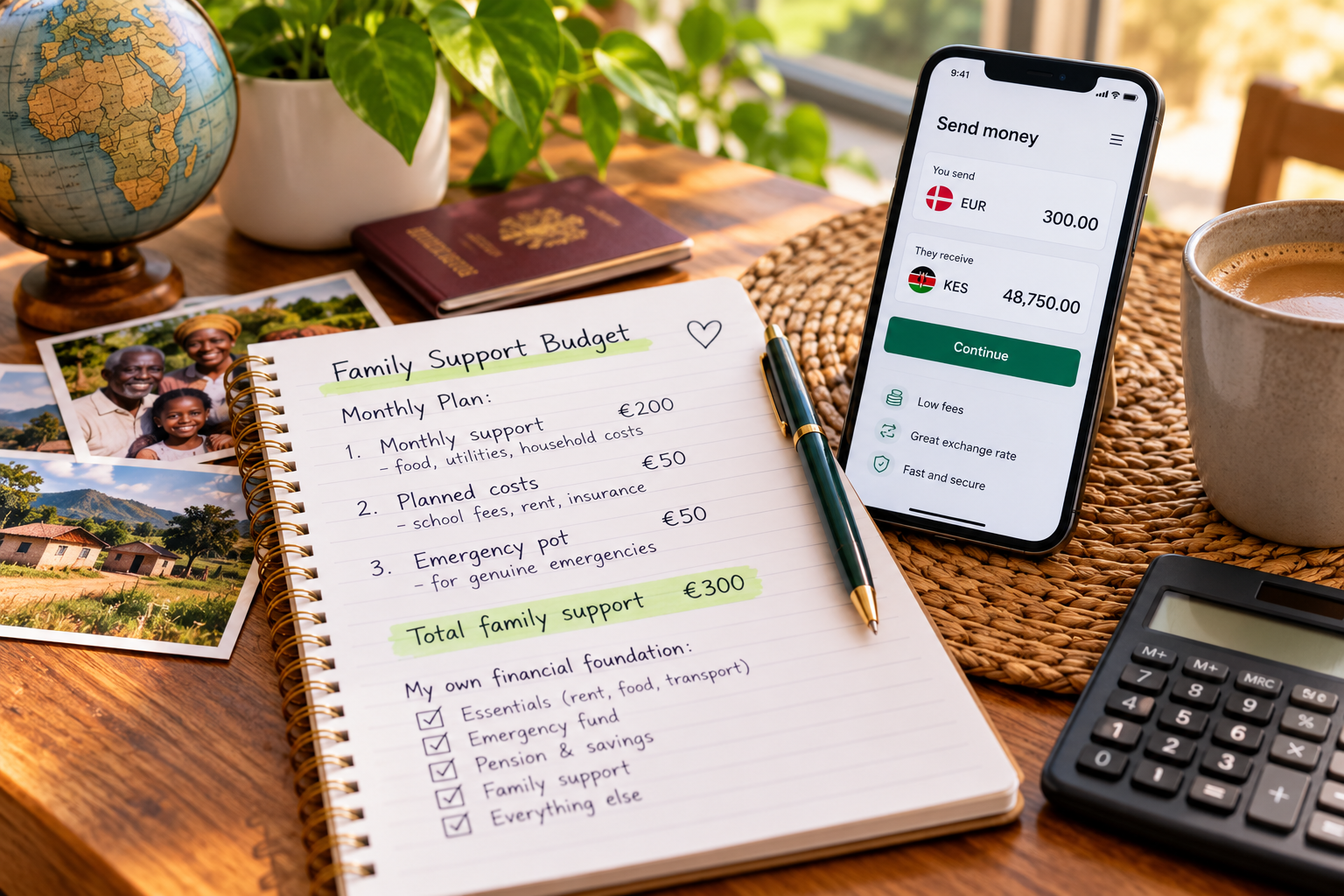
- Stabilize. Build an emergency reserve, deal with expensive debt and set a sustainable family-support budget. Our guide on how much to send home each month gives a simple formula.
- Grow. Increase the surplus available for saving and investing, without neglecting essential family needs.
- Invest. Allocate capital to diversified or carefully evaluated productive assets, with a plan for monitoring them. Explore the basics on our Investing for the Diaspora page.
- Legacy. Protect ownership, document beneficiaries, plan succession and teach the next generation how wealth is managed. Our Wealth & Legacy section covers this, and Spend the Income, Keep the Capital shows how an asset can support parents without eating your savings.
This order matters. Investing before you are stable often means selling at the worst moment when a family emergency arrives.
Things That Look Like Assets but Are Not
Some purchases feel like ownership but quietly take money out of your pocket:
- An empty house back home. It costs a caretaker, repairs and rates, yet earns nothing.
- A car bought on credit. It loses value every year while you pay interest.
- “Guaranteed” high-return schemes. If it sounds too good to be true, it usually is. We list more traps in Top 10 Financial Mistakes to Avoid When Moving Abroad.
- Land without a clean title. If you cannot prove you own it, you do not fully own it.
A useful test: does it put money in your pocket, or is it likely to grow in value? If neither, it is spending, however good it looks.
What Is Your Money Building?
The real question is not only how much you earn abroad. It is what the money you earn is building.
To help you take the first step, we put together the Smart Diaspora Money Starter Kit. It gives you a starting point to work out your net worth, plan family support, build an emergency reserve and identify how much you can invest each month.
Get the free Smart Diaspora Money Starter Kit
We are also building a Diaspora Wealth Planner and an investing course for people living abroad. Starter Kit readers will hear about them first.
Next in our From Income to Wealth series: How Immigrants Can Start Building Wealth Abroad. Explore more on our Investing page.
Smart Money Diaspora shares financial education, not personal financial, tax or legal advice. Tax rules, rates and thresholds change and depend on your residency and situation. The figures in this post are illustrative estimates, and investments can fall in value. Please check current rules with Skattestyrelsen, the Kenya Revenue Authority or a qualified adviser before making decisions.
Sources: Skattestyrelsen: Aktiesparekonto · KRA: Residential rental income tax · PwC Worldwide Tax Summaries: Kenya, taxes on personal income · EY: Kenya enacts Finance Act, 2026 · Citizen Digital: KRA issues new tax guidance for Kenyans living abroad with rental property