
How Much Should I Send Home? A Simple Monthly Budget for Family Support
By Martha Muigai · Smart Money Diaspora · Part of the Black Tax series · 6-minute read
It’s one of the most common questions I hear from people living abroad:
“How much should I actually be sending home?”
Usually it’s asked quietly, with a bit of guilt. Because for most of us, the honest answer has been: whatever was asked, whenever it was asked. A message arrives, we send. Another arrives, we send again. And at the end of the month we wonder where our savings went.
In my guide to black tax, I explained why supporting family is part of who we are, and why doing it without a plan can hurt both you and them. This post is the practical part: a simple, four-step way to decide how much to send each month, and how to stick to it without guilt.
Key Takeaways
- Start with your family’s real monthly gap, not with what’s asked.
- The gap is not automatically yours alone to fill. Share it.
- Decide what you can sustain without weakening your own financial foundation.
- Split the amount into three buckets: monthly support, planned costs, and an emergency pot.
- Send on a fixed day, pay big bills directly, and review once a year.
Step 1: Find Your Family’s Real Monthly Gap
Before you decide what to send, find out what’s actually needed. Call your family (or whoever manages the household) and fill in a simple worksheet together:
| Monthly household cost | Amount (local currency) |
|---|---|
| Food and household items | |
| Rent or housing | |
| Electricity, water, gas | |
| Medical costs and medication | |
| Transport | |
| School costs (spread per month) | |
| Total monthly costs | |
| Minus income they already have (pension, work, rent, farming, other relatives) | |
| = The real monthly gap |
That last line is your starting point. Not the loudest request. Not the biggest emergency. The gap.
Two things usually happen when families do this for the first time:
- The gap is smaller than expected, because planned spending is cheaper than emergency spending, and some costs were being covered twice.
- Or it’s bigger than expected, and it becomes clear that one person can’t cover it alone. That’s just as valuable to know.
Either way, you’re now working with facts rather than feelings.
Don’t Confuse the Family Gap With Your Responsibility
Here’s the part many of us miss: the family gap is not automatically one person’s responsibility.
Just because you’re the one abroad doesn’t mean the whole gap lands on you. Say the family’s monthly gap is €500. It could be covered like this:
| Who contributes | Monthly |
|---|---|
| You | €200 |
| A sibling | €150 |
| Another relative | €100 |
| Extra family income (e.g. selling produce) | €50 |
| Total gap covered | €500 |
When you see the gap written down, it becomes much easier to have an honest family conversation about who can contribute what, instead of everyone quietly assuming the person abroad will cover it all.
Step 2: Decide What You Can Sustainably Afford
Now turn to your own budget. The question isn’t “How much can I send this month?” It’s “How much can I keep sending, every month, for years?”
Look at your own monthly budget and cover these first:
- Your essentials: rent, food, transport, childcare, insurance, debt repayments.
- Your emergency fund: a buffer for your own household.
- Your pension and savings: even a small, regular amount.
What’s left after these is your monthly surplus, and that’s where sustainable family support comes from.
This doesn’t mean your family always comes last. Someone supporting an elderly parent with no other income is in a very different position from someone sending money for extras. Sometimes support is essential, and you’ll choose to save less for a while. The principle is simply this:
Protect your financial foundation before you commit to a level of family support you can’t sustain.
If you lose your job with no savings, two households are in trouble instead of one. Protecting yourself protects them.
| Your situation | Starting point |
|---|---|
| New abroad, still building your emergency fund | A small fixed amount you can sustain |
| Settled, emergency fund in place | An amount that fits your monthly surplus |
| Established, strong savings and fewer competing obligations | A larger amount may be sustainable |
| Sharing support with siblings or relatives | Your agreed share of the actual family gap |
There is no universal percentage that every immigrant should send home. The right amount depends on your income, essential expenses, debt, savings, dependants and the actual gap in your family. Don’t send based on what’s asked. Send based on what’s actually needed and what you can sustainably afford.
Step 3: Split It Into Three Buckets
A single lump sum gets spent on whatever is most urgent that week. Splitting your family-support budget into three buckets makes it go much further:
- Monthly allowance: sent on a fixed day for everyday living costs.
- Planned big costs: school fees, rent due annually, insurance. Saved monthly and paid when due.
- Family emergency pot: kept in your account and used only for genuine emergencies.
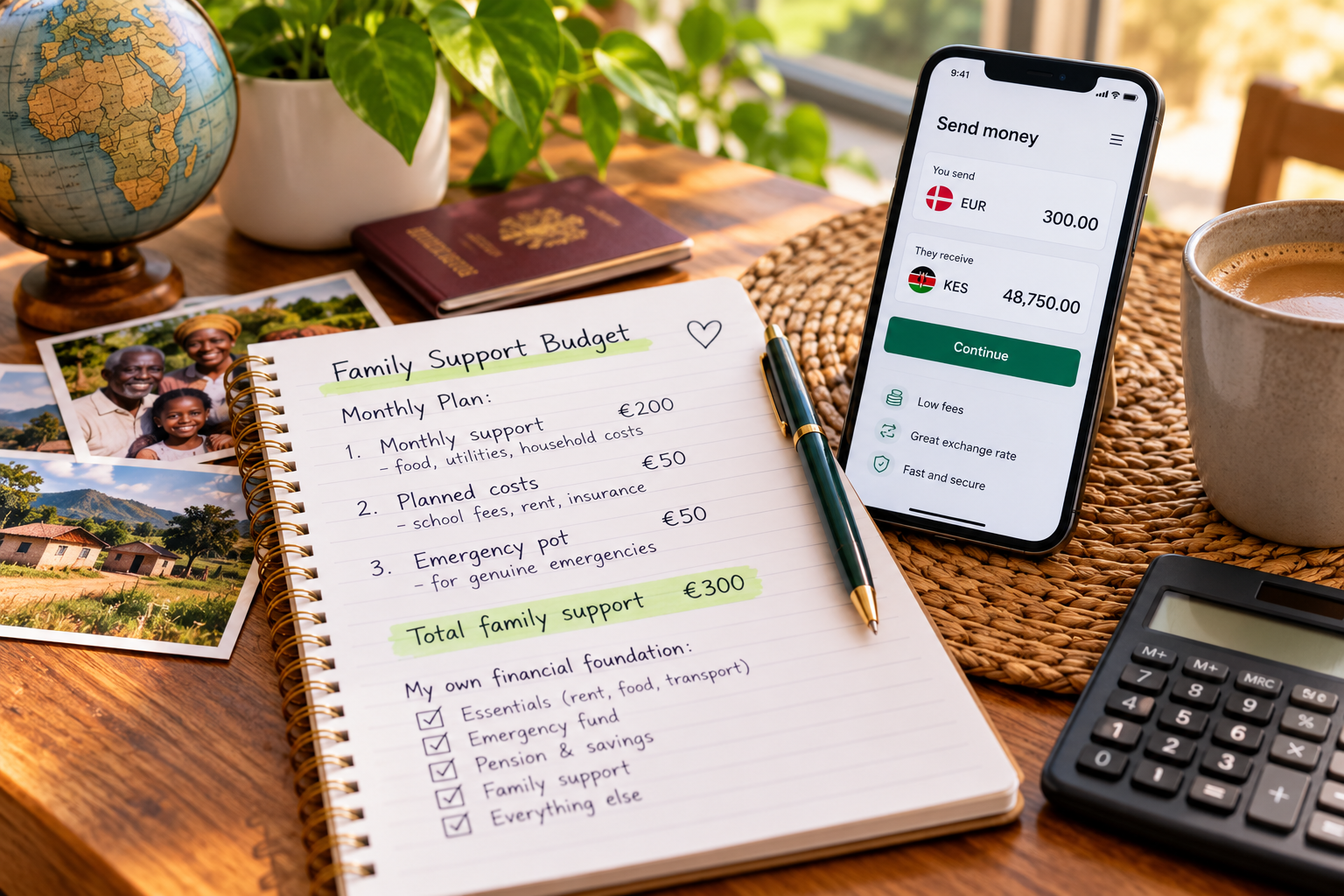
YOUR FAMILY SUPPORT BUDGET: €300 / month
| Bucket | Monthly | How it’s used |
|---|---|---|
| Monthly allowance | €200 | Sent on the 1st for food, utilities and household costs |
| School fees fund | €50 | Saved monthly, paid directly to the school each term |
| Emergency pot | €50 | Stays in your account; builds to €600 a year |
| Total | €300 | Illustrative family-support budget |
The emergency pot is the bucket that changes everything, but only if you use it correctly. The emergency pot is not a second monthly allowance. It’s a separate reserve for genuine, unexpected expenses: urgent medical treatment, a funeral, a serious repair that can’t wait. It isn’t for things that could have been planned, and it isn’t a fund that can be spent whenever someone asks.
Used this way, it protects everyone. When a real emergency arrives, you’re not choosing between your family and your own rent. You check the pot. And if a request isn’t a genuine emergency, or the pot is empty, you have an honest answer ready: “Let’s plan for this next month.”
Step 4: Make It Run Smoothly
- Send on a fixed day. The same date every month. Your family can plan around it, and you stop getting “is it coming?” messages.
- Automate it if your transfer provider allows scheduled payments.
- Compare transfer providers. Fees and exchange-rate margins vary a lot, and a few percent lost on every transfer adds up over a year.
- Pay big bills directly. Send school fees to the school and hospital bills to the hospital. It’s transparent and removes any pressure on whoever receives the money.
- Share the load. If siblings or relatives also earn, agree who covers what. One takes school fees, another covers groceries, another handles medical costs.
- Review once a year, or when your income or their situation changes. A pay rise can mean a little more support; a new baby or job loss on your side can mean a little less.
What to Say When You’re Asked for More
This is the hardest part. A few phrases that keep the door open without breaking your budget:
- “I’ve already sent this month’s support. Can we plan this for next month?”
- “Let me check the emergency pot and I’ll come back to you.”
- “I can’t cover all of it, but I can contribute this much. Can someone else help with the rest?”
- “I want to keep supporting you for years, not just this month. That’s why I stick to the plan.”
Saying no to one request isn’t saying no to your family. It’s saying yes to being able to help them next year, and the year after.
Frequently Asked Questions
What percentage of my salary should I send home? There’s no universal percentage. The right amount depends on your income, essential costs, debt, savings, dependants and your family’s actual monthly gap. Start with a fixed amount that fits your monthly surplus after your essentials and emergency fund, and review it once a year.
Should I send money home before building my own emergency fund? Send a smaller, fixed amount while you build your emergency fund, then increase it once you have a buffer. Without savings, one job loss puts both households at risk.
How do I handle emergencies if I send a fixed amount? Keep a separate family emergency pot in your own account, topped up monthly. Use it only for genuine emergencies like medical costs, and plan anything else for the following month.
What’s the cheapest way to send money home? Compare providers on both the fee and the exchange rate, since a poor rate can cost more than the fee. Check a few options before every large transfer.
One Plan, Many Years of Support
Sending money home is an act of love. A budget doesn’t take the love out of it. It makes sure you can keep giving, steadily and without resentment, for as long as your family needs you.
And once your monthly budget is in place, the next step is making it lighter: turning part of that support into assets that pay for themselves. I share how I approached this with our family home in Black Tax: What It Is, Why It Exists and How to Make It Sustainable.
Build Wealth. Create Choices. Leave a Legacy.
Get Your Free Diaspora Wealth Checklist
Family support is one of seven areas in my free checklist:
Income → Spending → Emergency Fund → Family Support → Savings → Investments → Wealth Goals
Use it alongside this budget to see how family support fits into your whole financial picture.
👉 Get the Free Diaspora Wealth Checklist
💬 Over to you: do you send a fixed amount home, or do you respond to requests as they come? What’s worked for your family? Tell me in the comments.
Keep reading: