
SMART MONEY DIASPORA

Build wealth beyond borders. Create a legacy that lasts.

Spend the Income, Keep the Capital: How to Build an Income for Your Parents

For many of us living abroad, supporting our parents is not a choice. It’s love, gratitude and responsibility, all rolled into one monthly transfer.

However, there’s a quiet question behind that transfer that few of us ask out loud: what happens if, one day, I can’t send it?

Maybe you lose your job. Perhaps you have a child, or your own costs rise. In some cases, you simply reach a point where you need to save for your own retirement. Meanwhile, your parents still need to eat, pay bills and see a doctor.

That’s why this final part of the Black Tax series is about a different approach. Instead of sending money forever, you build a pot of capital, invest it, and let your parents live on the income it produces. The capital stays. Only the returns are spent.

In part 3, I shared how I turned our family home into an income-producing farm. This post takes the same idea further, from livestock to investments, rental income and small businesses. In each case, the principle is the same: build an asset, and let the cash flow carry the cost.

The Black Tax Series

part 1: Understand Black Tax

part 2: Create a Family Support Budget

part 3: Turn a Family Asset Into Income

Part 4: Build Capital That Produces Family Income (you’re here)

New to the series? Start with part 1 →

Key Takeaways

  • Spend the income, keep the capital. Your parents live on the returns, while the original investment stays intact.
  • To estimate how much capital you need, use a simple formula: yearly need ÷ yearly return.
  • Cash-flow assets include government securities, money market funds, fixed deposits, dividend funds, rental property, farming and small businesses.
  • Protect the capital from inflation, currency swings, misuse and scams.
  • The cash flow can do more than pay bills. It can also fund a family business, without touching the capital.

The Idea: Capital and Income Are Not the Same Thing

As an accountant, I often think about money in two buckets.

Capital is the money you put to work: the investment, the asset, the tree. Income is what that capital produces: the interest, the rent, the milk, the fruit.

Most family support works like this: every month, money leaves your account, gets spent, and disappears. Next month, you start again from zero. In other words, you’re paying for the fruit, over and over, without ever planting a tree.

The capital approach flips that around:

Monthly transfers Spend the income, keep the capital
Where the money comes from Your salary, every month The returns from an investment
What happens to the money Spent and gone The capital stays; only the income is spent
If you lose your job Support stops Support continues
After 10 years Nothing left to show An asset that’s still working
What you’re building Ongoing reliance on your salary A source of income

Of course, this doesn’t mean monthly transfers are wrong. In many families, they’re essential, especially at the start. Rather, the goal is to gradually shift part of your support from your salary to an asset, so that over time, your parents depend less on you and more on something that keeps producing.

Think of it like planting a tree. You don’t eat the tree. You eat the fruit, and the tree keeps growing.

How Much Capital Do You Need?

This is where most people give up, because the number sounds big. However, the calculation itself is simple:

Before You Invest, Know These Three Numbers

1. Monthly family need: how much do your parents actually need each month?

2. Annual amount required: monthly need × 12.

3. Sustainable income from the asset: what can the investment realistically produce each year, after taxes, fees and allowing for inflation?

Then:

Capital target = Annual family need ÷ Sustainable annual income rate

Let’s walk through an example. Say your parents need €150 a month to cover food, utilities and basic costs. That’s €1,800 a year.

Next, the capital you need depends on the return your investment produces. (The rates below are for illustration only. Actual returns vary by country, product and year, so always check current rates. Also, to protect the capital from inflation, use the return your parents can actually spend, as explained further below.)

If the investment returns… Capital needed for €1,800 a year
6% a year €30,000
8% a year €22,500
10% a year €18,000
12% a year €15,000

One important reality check: this calculation is a planning illustration, not a guarantee. A 10% return doesn’t mean you’ll receive exactly 10% every year. Returns can change, taxes and fees can reduce what you actually receive, and some investments can lose value. The goal, therefore, isn’t simply to find the highest return. It’s to build a sustainable income stream while protecting the capital as much as reasonably possible.

You Don’t Have to Fund the Whole Thing

The biggest mistake is thinking you need the entire amount before you can start. You don’t.

Instead, you can start small and let the asset gradually take over part of the responsibility. Maybe today you send your parents €150 every month. Over time, an investment might cover €30 of that. Later, it might cover €50, and eventually €80. Meanwhile, the amount coming from your salary gets smaller, while the amount coming from the asset gets larger.

Here’s how that can work in practice:

1. Start with what you have. For example, €4,500 at 10% produces about €450 a year, roughly a quarter of a €1,800 need.

2. Keep sending the rest from your salary for now.

3. Add to the capital every year, from a bonus, a tax refund or part of your savings.

4. Reduce your monthly transfer as the investment income grows.

The goal isn’t to stop supporting your family. The goal is to stop being the only source of support.

Assets That Produce Cash Flow

Not every investment is suitable for this. Some assets, like land held for the future, may grow in value but produce no income today. For family support, you need cash-flow assets: things that pay you regularly while you still own them.

Here are the main options, from lower to higher effort.

1. Government securities

Treasury bills and government bonds pay interest, and in many countries they’re considered among the safer local investments. In Kenya, for example, they can be bought through the central bank or a licensed broker, and bonds typically pay interest twice a year. For that reason, they suit regular family support well.

2. Money market funds

A money market fund pools money from many investors into short-term, lower-risk instruments. Usually, you can add money easily and withdraw within days. As a result, many families use them as the “bank account” from which a monthly allowance is paid.

3. Fixed deposits

A fixed deposit locks your money with a bank for a set period at an agreed interest rate. It’s simple and predictable. On the other hand, your money is tied up until the term ends.

4. Dividend-paying funds or shares

Some companies and funds pay part of their profits to investors as dividends. Over the long term, they can grow both income and capital. However, dividends and share prices can fall, so they suit money you won’t need for years.

5. Rental property

A rental room, a small block of flats or a commercial space can produce monthly rent. Moreover, it’s tangible and familiar for many families. Even so, property needs management, repairs and tenants who pay on time, which is harder from abroad.

6. Agricultural assets

Livestock, poultry, fruit trees or crops can produce regular income. This is exactly what I did with our family home, which you can read about in part 3 of this series. That said, farming needs the right person on the ground, good records and a reserve for difficult seasons.

7. A small business

A shop, a posho mill, a salon or a transport business can produce daily income. Of all the options, it has the highest potential and the highest risk, and it depends heavily on the person running it.

Comparing the options

Asset Effort to manage Income Main risk
Government securities Low Regular interest Inflation, currency
Money market funds Low Regular, flexible Fund quality, inflation
Fixed deposits Low Fixed interest Locked money, inflation
Dividend funds or shares Low to medium Varies Market falls
Rental property Medium to high Monthly rent Vacancies, repairs
Farming High Seasonal or daily Disease, weather
Small business High Daily, varies Management, failure

For many diaspora families, a lower-effort, regulated investment may be easier to manage initially, particularly when the goal is to create predictable cash flow from abroad. Later, once that foundation is in place, a higher-effort asset like rental property, farming or a business can be added. Ultimately, though, the right choice depends on your country, tax position, risk tolerance, time horizon and circumstances.

Protecting the Capital

The whole idea only works if the capital survives. Therefore, protecting it matters just as much as choosing the right asset.

Don’t spend all the interest: beat inflation

This is the mistake most people don’t see coming. Prices rise every year, so if your parents spend every shilling of interest, the capital slowly loses its buying power. After ten years, the same capital buys far less food.

The solution is simple: reinvest part of the return. For example, if the investment earns 10% and inflation is 6%, your parents could spend around 4% and you reinvest the rest. That way, the capital keeps pace with rising prices, and so does the income.

Spend the real return. Reinvest enough to keep up with inflation.

Watch the currency

When you invest in your home currency, your returns are earned in that currency too. That’s fine for local costs like food and school fees. However, if the currency weakens, the capital is worth less in euros. So if you’re investing a large amount, it may make sense to spread it across more than one currency.

Keep control of the capital

For the same reason you’d protect any investment, keep it in your name, or in a structure you control. Then pay the agreed income to your parents. This isn’t about mistrust. Rather, it protects everyone from pressure to “just use some of the capital this once.”

Agree the rules up front

Talk openly with your parents and siblings about how it works:

  • The capital is not touched, except in a true emergency agreed by everyone.
  • Only the income is paid out, on a fixed day each month or quarter.
  • Big costs are planned separately, not taken from the capital.

Avoid “too good to be true”

Finally, be very careful with schemes promising guaranteed high returns, especially when they’re sold through friends, churches or WhatsApp groups. Before investing, check that the provider is licensed by the relevant regulator in that country. If the promise sounds too good to be true, it usually is.

Beyond Bills: Using the Cash Flow to Start a Business

Once the basics are covered, the cash flow can do something even more powerful: create new income.

For example, imagine the investment income covers your parents’ food and utilities, with a little left over each quarter. Instead of spending that surplus, the family could save it and use it as seed capital for a small business, perhaps poultry, a kiosk, or tailoring for a sibling who’s ready to work.

The key rule stays the same: the business is funded from the income, never from the capital. As a result, if the business struggles, your parents’ basic income is still safe.

Here’s how that can grow over time:

In this way, one asset can lead to another. Similarly, our farm started with one cow and four sheep, and the animals that were born became new assets in their own right. Likewise, a well-run business can eventually produce enough to add to the capital, so the whole system keeps growing.

In fact, the farm taught me something important: an asset doesn’t have to be large to be useful. It has to be productive, managed properly and allowed to grow.

One cow produces milk. Sheep reproduce. The milk generates cash, and the cash maintains the home. Meanwhile, the animals themselves remain assets. The same principle applies to financial investments:

The asset is the engine. The income is what you use.

A few guidelines help:

  • Start small, with money the family can afford to lose.
  • Release money in stages as the business shows results.
  • Choose the right person to run it, someone willing and able.
  • Keep simple records of sales and costs, just as we do on the farm.

That way, family support stops being only a cost. Instead, it becomes the start of a family enterprise.

Your Step-by-Step Plan

If you’d like to start, here’s a simple path to follow.

1. Know the need. First, work out your parents’ real monthly gap, as described in part 2 of this series.

2. Protect yourself first. Before investing for family, make sure your own emergency fund is in place.

3. Calculate the target. Next, use the formula: yearly need ÷ yearly return you can spend.

4. Choose a low-effort asset to begin with, such as government securities or a money market fund, from a licensed provider.

5. Start with what you have. Even a quarter of the target is a meaningful beginning.

6. Agree the rules with your parents and siblings: capital untouched, income paid on a fixed day.

7. Keep sending the rest from your salary while the asset grows.

8. Add to the capital whenever you can, and reinvest part of the returns.

9. Review once a year. Then, as the income grows, reduce your monthly transfer.

10. Consider a second asset later, such as rental income, farming or a small business, funded from the surplus.

Above all, remember that this is a long game. Every euro you move from “monthly cost” to “working capital” makes your family more secure, and makes you a little freer.

Frequently Asked Questions

What does “spend the income, keep the capital” mean? It means investing a lump sum and living only on the income it produces, such as interest, dividends or rent. Because the original capital stays invested, it keeps producing income year after year.

How much do I need to invest to give my parents a monthly income? Divide the yearly amount they need by the yearly return you can spend. For example, €1,800 a year at a 10% return needs about €18,000. However, you can start with less and build up over time.

What are good income-producing investments back home? Lower-effort options include government securities, money market funds and fixed deposits from licensed providers. Higher-effort options include rental property, farming and small businesses. Always check current rates and the provider’s regulation.

Can investment income be used to start a business? Yes. Once your parents’ basic needs are covered, any surplus income can be saved as seed capital for a small family business. Just make sure the business is funded from the income, never from the capital.

The End of the Series, the Start of a Legacy

When I started this series, I wanted to answer one question: how can we support our families without sacrificing our own future?

In part 1, we looked at what black tax is and why it exists. Then, in part 2, we built a monthly budget. After that, in part 3, I shared how our family home became an income-producing farm. Finally, in this post, we’ve seen how capital can give our parents an income that doesn’t depend on our salaries.

Together, they point to one simple idea:

Don’t just send money. Build something that keeps sending it for you.

Supporting family will always be part of who we are. However, the way we support them can change, from a cost we carry forever to an asset that carries the cost for us.

Build Wealth. Create Choices. Leave a Legacy.

Ready to Build Your Plan?

Before you invest a single euro, make sure your own foundation is solid. My free checklist walks you through:

Income → Spending → Emergency Fund → Family Support → Savings → Investments → Wealth Goals

👉 Get the Free Diaspora Wealth Checklist

💬 Over to you: have you built an asset that supports your parents or family? Or are you just getting started? Share your story or question in the comments. I read every one.

The Black Tax Series:

1. Black Tax: What It Is, Why It Exists and How to Make It Sustainable

2. How Much Should I Send Home? A Simple Monthly Budget for Family Support

3. How I Turned Our Family Home Into an Income-Producing Farm

4. Spend the Income, Keep the Capital: How to Build an Income for Your Parents (you’re here)

New here? Begin with Start Here, then explore Save & Invest.

This article is for general education and isn’t personal financial advice. Returns are never guaranteed, so check current rates and speak to a licensed adviser for your situation.

How I Turned Our Family Home Into an Income-Producing Farm

By Martha Muigai · Smart Money Diaspora · Part 3 of the Black Tax Series · 8-minute read

I didn’t want to keep sending money home forever. So I built an income-producing farm.

Our Childhood Home

My parents were hardworking people.

Everything they had, they built with their own hands. In fact, the home they left behind was not just a building; it held years of sacrifice, hard work and love. Above all, it was our family home: the place where we grew up, filled with memories.

However, after my parents passed away, life changed.

Like many families spread across different countries, we each carried on with our own responsibilities. Some of us were abroad, while others were building their own families and careers. As a result, the home slowly became neglected.

For more than seven years, our family home stood mostly abandoned. During that time, the compound became overgrown, and a place that once had so much life became quiet and forgotten.

It wasn’t because we didn’t care. Instead, life simply moved on, and distance made it hard to stay connected to a property thousands of kilometres away.

My Brother Stepped In

Eventually, my brother decided to step in.

My brother took responsibility for the home and started looking after it. In many ways, he became the person who made sure our family home wasn’t completely lost, and he gave it attention when it needed it most.

Then, in 2024, my brother passed away.

Losing him brought everything back. Above all, it reminded me of a promise I had made after losing my parents:

I would not allow our family home to be abandoned.

At that moment, I realised that preserving my parents’ legacy, and the care my brother had given it, was now my responsibility.

Keeping My Promise From Denmark

But living in Denmark created a practical challenge: how do you take care of a family home when you’re thousands of kilometres away?

Of course, the easiest answer would have been to send money every month, whenever something needed attention. However, I started thinking differently:

Instead of creating another permanent expense, could I turn the property into something productive? Could the land help generate the income to support the home?

That question changed everything. So I decided not only to maintain the home, but also to build something that could support it. To begin with, I started a small livestock project with:

  • One dairy cow
  • Four sheep

My goal wasn’t to build a large farm overnight. Instead, I wanted to create a productive asset that could grow, support the home, provide employment, and teach me how to manage something from abroad.

Since then, what started as a way to protect my parents’ legacy has become much more. It has become a journey into farming, entrepreneurship and building wealth across borders.

Here’s the full story.

Key Takeaways

  • A family home back home is a recurring cost, not just a sentimental asset.
  • I turned that cost into a small income-producing farm, starting with one dairy cow and four sheep.
  • Two years later, the flock has grown to more than 20 sheep, and the cow has had a calf and is pregnant again.
  • The most important investment wasn’t the animals. It was the person managing them, and a simple, transparent system.
  • The bigger lesson: before you pay for the same need every month, ask whether an asset could help carry the cost.

The Problem: A Family Home Back Home Still Has Costs

You can own land or a family home in your country of origin, but distance doesn’t remove the responsibilities that come with it. For example, a home still needs:

  • Someone to look after it
  • Compound maintenance and repairs
  • Security
  • Bills
  • Regular attention

And when you live abroad, these costs usually become one more monthly request: “Please send money for the house.”

The challenge is that some expenses never really end. School fees eventually finish, and a medical bill gets paid. A property, on the other hand, can need maintaining for years.

I realised that if I only kept sending money, I would always be funding a cost. In other words, the house would stay important emotionally, but financially it would always depend on income from abroad.

Because of my accounting background, I naturally started looking at it differently. So I asked myself: Is this only an expense, or can it become an asset?

The Idea: Let the Asset Help Carry the Cost

The family home already had two important things: land, and a need for someone to be present.

After all, if someone needed to be there anyway, what if their work could also create income? Instead of paying someone only to watch over an empty home, what if the property could support something productive?

For my situation, livestock made sense, and the idea was simple:

Land → Livestock → Income → Caretaker + Home Maintenance

In other words, I wasn’t trying to build a large commercial farm overnight. Rather, I wanted something productive that could grow over time.

Starting Small: One Cow and Four Sheep

I didn’t start big. Instead, I started with:

  • One dairy cow
  • Four sheep

Size wasn’t the point; rather, I wanted to build a system that could grow.

In addition, the initial investment was planned to cover more than just the animals:

  • The caretaker’s costs
  • Veterinary care
  • Animal feed
  • Basic farm needs
  • A reserve for unexpected situations

I wanted the project to have breathing space, because farming is never completely predictable. For instance, animals get sick, weather changes and costs rise. That’s why a good agricultural project needs to be prepared for difficult periods.

Two Years Later: The Asset Started Growing

So far, the most encouraging part of this journey has been watching the project grow.

  When I started Two years later
Sheep 4 More than 20, after selling 4
Cattle 1 dairy cow The cow has had a calf and is pregnant again

This is where the difference between an expense and an asset becomes clear. Money spent on an expense disappears. Money invested in a productive asset keeps creating value.

As the animals grow, the asset grows, and the possibilities grow with it.

The Most Important Investment Was the Person Managing It

Many people focus on what to invest in back home. Land? Livestock? Property? A business?

But from my experience, the most important decision wasn’t the animals. It was the person managing them.

When you live abroad, trust is one of the biggest challenges. Fortunately, my neighbours helped me find someone to look after the animals and the home. The caretaker’s responsibilities include:

  • Feeding the animals
  • Milking the cow
  • Managing grazing
  • Looking after the sheep
  • Maintaining the compound
  • Sending me updates about the farm

This taught me a valuable lesson: when investing back home, people are part of the investment. You can have good land, good animals and enough capital. Even so, without the right person and the right systems, the investment can fail.

And there’s a bonus: the farm created a job. Someone has steady work because of it.

How I Manage the Farm From Denmark

One of the biggest worries for people living abroad is: “How do I know the money isn’t being misused when I’m so far away?”

For me, transparency was important from the very beginning. Therefore, I set up a simple system:

  • The milk buyer pays directly into a Kenyan bank account. Cash never has to change hands.
  • From that account, I pay the caretaker and the suppliers.
  • Every farm expense is recorded.

How the money flows

[embed: node/544322ff-421a]

We also keep simple records of:

  • Number of animals
  • Births
  • Sales
  • Milk production
  • Expenses
  • Farm activities

As a result, I have visibility even from Denmark. The system isn’t complicated; in fact, it’s based on one principle:

Know what comes in, know what goes out, and keep records.

When you’re managing an asset from abroad, transparency is your protection.

The Reality: It Hasn’t Always Been Easy

Of course, building something from abroad doesn’t remove challenges. Instead, it creates different ones.

Animal disease has been one of the biggest. Like any livestock farmer, you have to deal with unexpected health problems. After all, vet costs are part of farming, and animals need continuous attention.

Dry seasons have been another. During those periods, when grazing is limited, we’ve had to buy extra feed to keep the animals healthy.

This taught me an important lesson: an asset still needs investment to keep producing. Many people focus only on the income. However, successful assets need maintenance, management, problem-solving and patience. In fact, this is exactly what the reserve I planned at the start is for.

More Than Maintaining a Home: Building Skills for the Future

When I started, my goal was simple: take care of our family home and make sure it was never abandoned again.

But over time, I realised something else was happening. This project was teaching me how to manage a farm from thousands of kilometres away, with lessons you can’t learn only from books:

  • Managing livestock remotely
  • Working with people on the ground
  • Creating systems and accountability
  • Monitoring production and expenses
  • Making decisions when unexpected problems happen

Although it’s still a small project, it has given me real experience in agricultural management and entrepreneurship. For many of us abroad, however, the biggest gap isn’t ideas; it’s practical experience of managing something back home.

This project has become my classroom.

Planting the Seed for a Bigger Dream

Sometimes small beginnings reveal bigger possibilities.

What started as a way to protect my family home has planted a much bigger dream: a larger-scale livestock farm in the future. And not just a farm that produces animals, but one that understands the whole value chain:

  • Better livestock management
  • Improved breeding systems
  • Supporting other farmers with knowledge
  • Reliable production systems
  • Adding value to agricultural products

For example, instead of only selling milk, there’s potential to explore processed products. Similarly, beyond selling animals, there’s room to build stronger livestock systems.

In short, this small farm has shown me what’s possible. Every big vision starts with a small experiment.

The Bigger Lesson: Change the Shape of Family Support

This experience changed how I think about black tax.

Family support is usually discussed as money leaving your account. But what if we change the question? Instead of only asking “How much should I send home?” (which I cover in part 2 of this series), we could also ask:

“Can part of this support create something productive?”

Of course, the answer will be different for every family. For example, it might be livestock, a rental property, a small business, farming, investments or education.

In other words, the goal isn’t to stop supporting family; it’s to make that support more sustainable. There’s a big difference between sending money forever to cover a cost and building something that helps cover that cost.

What I’d Tell Anyone Considering Something Similar

This approach won’t work for everyone, and livestock isn’t automatically the right investment. The lesson isn’t “Everyone should buy cows and sheep.” The lesson is: look at your recurring family costs and ask whether an asset could help carry them.

If you’re considering something similar:

  • Start with the problem, not the investment. What cost are you trying to solve? How much does it need? What could realistically support it?
  • Choose people carefully. The person managing the asset is critical. Trust matters, but systems matter too.
  • Expect challenges. Plan for disease, weather, repairs and unexpected costs, and keep a reserve.
  • Start small. A small project you can manage well beats a big one you can’t monitor.
  • Keep records. Track income, expenses, animals, sales and production.
  • Stay connected. Distance shouldn’t mean disappearing. Regular calls, photos and updates protect the investment.

Frequently Asked Questions

How do I maintain a family home back home while living abroad? The usual approach is a monthly transfer for upkeep and someone to look after it. However, a more sustainable option is to make the property productive, for example with livestock, crops or a small rental, so its income helps cover the caretaker and the upkeep.

Can a small livestock project really grow? It can, with good management and patience. For example, I started with one dairy cow and four sheep. Two years later, the flock is over 20 sheep after selling four, and the cow has had a calf and is pregnant again. Even so, plan for vet costs, feed in dry seasons, and losses.

How do I manage a farm back home from abroad? Choose a caretaker you trust (I found mine through neighbours), have buyers pay directly into a bank account, pay wages and suppliers from that account, keep simple records, and ask for regular updates and photos.


From Cost to Legacy

After seven years of neglect, and after losing my brother, who had stepped in to care for it, I promised myself our family home would never be abandoned again.

Today, the home isn’t simply being maintained. Instead, it’s productive and supports a livelihood. At the same time, it’s teaching me entrepreneurship and planting the seed for a bigger agricultural dream. And most importantly, it continues the legacy my parents started.

That’s the lesson I want to share through Smart Money Diaspora: wealth isn’t only about what you earn abroad. It’s about what you build with what you earn.

Supporting family matters. However, whenever we can, let’s also build assets that keep supporting the future. After all, true wealth isn’t only what we leave behind. It’s what keeps working after us.

Build Wealth. Create Choices. Leave a Legacy.


Is Your Family Support Building Anything?

If you’re sending money home every month, take ten minutes to see where it fits in your bigger financial picture. My free checklist walks you through:

Income → Spending → Emergency Fund → Family Support → Savings → Investments → Wealth Goals

👉 Get the Free Diaspora Wealth Checklist

💬 Over to you: have you ever turned a family expense into something productive, like a farm, a rental, a business or an investment? I’d love to hear your story in the comments. Your idea might help someone else abroad think differently about wealth.

The Black Tax series:

  1. Black Tax: What It Is, Why It Exists and How to Make It Sustainable
  2. How Much Should I Send Home? A Simple Monthly Budget for Family Support
  3. How I Turned Our Family Home Into an Income-Producing Farm (you’re here)

New here? Begin with Start H

Budgeting a monthly amount to send home to family

How Much Should I Send Home? A Simple Monthly Budget for Family Support

By Martha Muigai · Smart Money Diaspora · Part of the Black Tax series · 6-minute read

It’s one of the most common questions I hear from people living abroad:

“How much should I actually be sending home?”

Usually it’s asked quietly, with a bit of guilt. Because for most of us, the honest answer has been: whatever was asked, whenever it was asked. A message arrives, we send. Another arrives, we send again. And at the end of the month we wonder where our savings went.

In my guide to black tax, I explained why supporting family is part of who we are, and why doing it without a plan can hurt both you and them. This post is the practical part: a simple, four-step way to decide how much to send each month, and how to stick to it without guilt.

Key Takeaways

  • Start with your family’s real monthly gap, not with what’s asked.
  • The gap is not automatically yours alone to fill. Share it.
  • Decide what you can sustain without weakening your own financial foundation.
  • Split the amount into three buckets: monthly support, planned costs, and an emergency pot.
  • Send on a fixed day, pay big bills directly, and review once a year.

Step 1: Find Your Family’s Real Monthly Gap

Before you decide what to send, find out what’s actually needed. Call your family (or whoever manages the household) and fill in a simple worksheet together:

Monthly household cost Amount (local currency)
Food and household items
Rent or housing
Electricity, water, gas
Medical costs and medication
Transport
School costs (spread per month)
Total monthly costs
Minus income they already have (pension, work, rent, farming, other relatives)
= The real monthly gap

That last line is your starting point. Not the loudest request. Not the biggest emergency. The gap.

Two things usually happen when families do this for the first time:

  • The gap is smaller than expected, because planned spending is cheaper than emergency spending, and some costs were being covered twice.
  • Or it’s bigger than expected, and it becomes clear that one person can’t cover it alone. That’s just as valuable to know.

Either way, you’re now working with facts rather than feelings.

Don’t Confuse the Family Gap With Your Responsibility

Here’s the part many of us miss: the family gap is not automatically one person’s responsibility.

Just because you’re the one abroad doesn’t mean the whole gap lands on you. Say the family’s monthly gap is €500. It could be covered like this:

Who contributes Monthly
You €200
A sibling €150
Another relative €100
Extra family income (e.g. selling produce) €50
Total gap covered €500

When you see the gap written down, it becomes much easier to have an honest family conversation about who can contribute what, instead of everyone quietly assuming the person abroad will cover it all.

Step 2: Decide What You Can Sustainably Afford

Now turn to your own budget. The question isn’t “How much can I send this month?” It’s “How much can I keep sending, every month, for years?”

Look at your own monthly budget and cover these first:

  1. Your essentials: rent, food, transport, childcare, insurance, debt repayments.
  2. Your emergency fund: a buffer for your own household.
  3. Your pension and savings: even a small, regular amount.

What’s left after these is your monthly surplus, and that’s where sustainable family support comes from.

This doesn’t mean your family always comes last. Someone supporting an elderly parent with no other income is in a very different position from someone sending money for extras. Sometimes support is essential, and you’ll choose to save less for a while. The principle is simply this:

Protect your financial foundation before you commit to a level of family support you can’t sustain.

If you lose your job with no savings, two households are in trouble instead of one. Protecting yourself protects them.

Your situation Starting point
New abroad, still building your emergency fund A small fixed amount you can sustain
Settled, emergency fund in place An amount that fits your monthly surplus
Established, strong savings and fewer competing obligations A larger amount may be sustainable
Sharing support with siblings or relatives Your agreed share of the actual family gap

There is no universal percentage that every immigrant should send home. The right amount depends on your income, essential expenses, debt, savings, dependants and the actual gap in your family. Don’t send based on what’s asked. Send based on what’s actually needed and what you can sustainably afford.

Step 3: Split It Into Three Buckets

A single lump sum gets spent on whatever is most urgent that week. Splitting your family-support budget into three buckets makes it go much further:

  1. Monthly allowance: sent on a fixed day for everyday living costs.
  2. Planned big costs: school fees, rent due annually, insurance. Saved monthly and paid when due.
  3. Family emergency pot: kept in your account and used only for genuine emergencies.

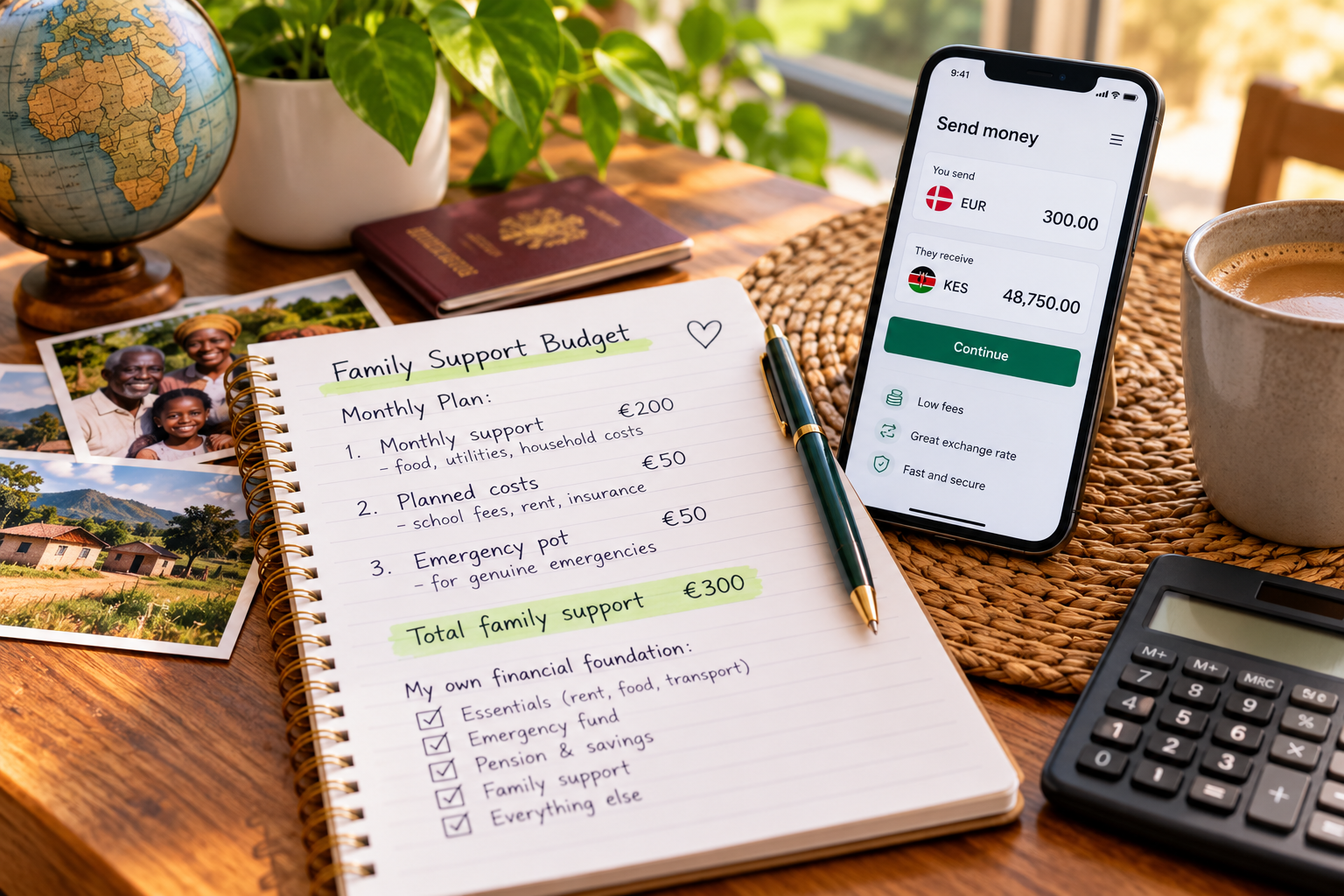
YOUR FAMILY SUPPORT BUDGET: €300 / month

Bucket Monthly How it’s used
Monthly allowance €200 Sent on the 1st for food, utilities and household costs
School fees fund €50 Saved monthly, paid directly to the school each term
Emergency pot €50 Stays in your account; builds to €600 a year
Total €300 Illustrative family-support budget

The emergency pot is the bucket that changes everything, but only if you use it correctly. The emergency pot is not a second monthly allowance. It’s a separate reserve for genuine, unexpected expenses: urgent medical treatment, a funeral, a serious repair that can’t wait. It isn’t for things that could have been planned, and it isn’t a fund that can be spent whenever someone asks.

Used this way, it protects everyone. When a real emergency arrives, you’re not choosing between your family and your own rent. You check the pot. And if a request isn’t a genuine emergency, or the pot is empty, you have an honest answer ready: “Let’s plan for this next month.”

Step 4: Make It Run Smoothly

  • Send on a fixed day. The same date every month. Your family can plan around it, and you stop getting “is it coming?” messages.
  • Automate it if your transfer provider allows scheduled payments.
  • Compare transfer providers. Fees and exchange-rate margins vary a lot, and a few percent lost on every transfer adds up over a year.
  • Pay big bills directly. Send school fees to the school and hospital bills to the hospital. It’s transparent and removes any pressure on whoever receives the money.
  • Share the load. If siblings or relatives also earn, agree who covers what. One takes school fees, another covers groceries, another handles medical costs.
  • Review once a year, or when your income or their situation changes. A pay rise can mean a little more support; a new baby or job loss on your side can mean a little less.

What to Say When You’re Asked for More

This is the hardest part. A few phrases that keep the door open without breaking your budget:

  • “I’ve already sent this month’s support. Can we plan this for next month?”
  • “Let me check the emergency pot and I’ll come back to you.”
  • “I can’t cover all of it, but I can contribute this much. Can someone else help with the rest?”
  • “I want to keep supporting you for years, not just this month. That’s why I stick to the plan.”

Saying no to one request isn’t saying no to your family. It’s saying yes to being able to help them next year, and the year after.

Frequently Asked Questions

What percentage of my salary should I send home? There’s no universal percentage. The right amount depends on your income, essential costs, debt, savings, dependants and your family’s actual monthly gap. Start with a fixed amount that fits your monthly surplus after your essentials and emergency fund, and review it once a year.

Should I send money home before building my own emergency fund? Send a smaller, fixed amount while you build your emergency fund, then increase it once you have a buffer. Without savings, one job loss puts both households at risk.

How do I handle emergencies if I send a fixed amount? Keep a separate family emergency pot in your own account, topped up monthly. Use it only for genuine emergencies like medical costs, and plan anything else for the following month.

What’s the cheapest way to send money home? Compare providers on both the fee and the exchange rate, since a poor rate can cost more than the fee. Check a few options before every large transfer.

One Plan, Many Years of Support

Sending money home is an act of love. A budget doesn’t take the love out of it. It makes sure you can keep giving, steadily and without resentment, for as long as your family needs you.

And once your monthly budget is in place, the next step is making it lighter: turning part of that support into assets that pay for themselves. I share how I approached this with our family home in Black Tax: What It Is, Why It Exists and How to Make It Sustainable.

Build Wealth. Create Choices. Leave a Legacy.

Get Your Free Diaspora Wealth Checklist

Family support is one of seven areas in my free checklist:

Income → Spending → Emergency Fund → Family Support → Savings → Investments → Wealth Goals

Use it alongside this budget to see how family support fits into your whole financial picture.

👉 Get the Free Diaspora Wealth Checklist

💬 Over to you: do you send a fixed amount home, or do you respond to requests as they come? What’s worked for your family? Tell me in the comments.

Keep reading:

Black Tax: What It Is, Why It Exists and How to Make It Sustainable

 Martha Muigai · Smart Money Diaspora · Part 1 of the Black Tax Series

Supporting family is part of who we are. Doing it without a plan doesn’t have to be.

It usually starts with a message.

“Hope you’re well. Mum’s medicine has run out.” Then another: “The school fees are due on Friday.” And sometimes: “The roof is leaking again.”

If you’re part of the diaspora, you know these messages. You also know the feeling that comes with them: love, duty, guilt and, at times, a quiet panic as you check your balance.

Many of us have a name for this. We call it black tax.

I’ve paid it, and I still pay it. Even so, I don’t believe the answer is to stop. Instead, after years of supporting family from abroad, I’ve learned that how you support your family matters as much as how much. Support without a plan can drain you for decades and still leave your family in the same place. Support with a plan, on the other hand, can make your family more secure and free you to build your own future too.

THE BLACK TAX SERIES

Part 1: Understand Black Tax (you’re here)

Part 2: Create a Family Support Budget

Part 3: Turn a Family Asset Into Income

Part 4: Build Capital That Produces Family Income

Key Takeaways

  • Black tax is the financial support you’re expected to give family once you “make it”, especially when you earn more or live abroad.
  • It exists because of income gaps, missing safety nets and a culture of shared responsibility, not because anyone is greedy.
  • Left unplanned, it can leave both you and your family without security.
  • A sustainable approach moves step by step: understand the need, budget for it, share it, and build assets that help carry the cost.

What Is Black Tax?

Black tax is the money, time and resources that a person who has become financially better off is expected to give to their parents, siblings and extended family.

The term became popular in South Africa, where it describes the pressure on Black professionals, often the first in their family to go to university or earn a steady salary, to support the people who helped them get there. In 2019, the book Black Tax: Burden or Ubuntu?, edited by Niq Mhlongo, brought the debate into the mainstream.

Today, the phrase is used far beyond South Africa, across Africa, the Caribbean and the wider diaspora. In fact, the experience isn’t limited to one race or region at all. Many immigrant families from Asia, Latin America and the Middle East know it well, even if they call it something else.

In practice, black tax can look like:

  • School or university fees for siblings, nieces and nephews
  • Parents’ rent, food, utilities and medical bills
  • Contributions to weddings, funerals and community fundraisers
  • Building or repairing the family home
  • Loans that are rarely paid back
  • Being the answer to every family emergency

It’s called a tax because it can feel compulsory. However, unlike a real tax, there’s no rate, no ceiling and no end date, unless you create one.

Why Does Black Tax Exist?

It’s easy to describe black tax as families being demanding. That isn’t fair, and it isn’t accurate either. Black tax exists for real, structural reasons.

Historical inequality. Colonialism, apartheid and decades of economic exclusion meant many families never had the chance to build wealth that could be passed down. When there’s no inheritance and no family savings to fall back on, the first person to earn a good income naturally becomes the safety net.

Missing safety nets. Here in Denmark, the state covers much of what families elsewhere cover themselves: pensions, healthcare, unemployment support and education. In many of our home countries, however, those systems are limited or unreliable. As a result, the family is the pension, the health insurance and the unemployment benefit.

The income gap. When you earn in euros, pounds or dollars and your family earns in a currency worth a fraction of that, even a small share of your salary can change their month. Because of that gap, the expectation feels natural on both sides.

Sacrifice and gratitude. Many of us are where we are because someone sold land, took a loan or went without so we could study or travel. For that reason, supporting them isn’t only duty. It’s gratitude.

Ubuntu. “I am because we are.” In many cultures, success is shared. Your achievement belongs to the family, and sharing it is part of who you are.

So black tax isn’t simply a burden. It’s also love, loyalty and community. The problem isn’t that it exists. The problem is when it’s unplanned, unlimited and never builds anything lasting.

The Hidden Cost of Unplanned Black Tax

When support has no plan, it quietly costs you, and often your family too.

  • You never build your own safety net. Without an emergency fund, a pension or investments, one job loss puts two households in trouble.
  • Nothing grows. Money that only covers this month’s needs has to be sent again next month.
  • The cycle repeats. If you reach retirement with nothing, your own children may end up paying black tax for you.
  • Relationships get strained. Resentment builds on one side, while uncertainty builds on the other.
  • You burn out. Many of us carry this silently, and over time it weighs on our health and peace of mind.

In other words, the goal isn’t to stop helping. Rather, it’s to help in a way that you can keep up for years, and that leaves your family stronger over time.


A Better Way: Four Steps to Sustainable Support

Over the years, I’ve come to see sustainable family support as a journey with four stages. Each part of this series covers one of them in depth.

Step 1: Understand the real need

First, find out what your family actually needs each month. List their costs, subtract any income they already have, and you’ll see the real gap. Often it’s smaller than the total of all the ad-hoc requests. Sometimes it’s bigger than you realised, which is just as important to know.

Step 2: Budget for it, and share it

Next, decide what you can sustainably contribute after protecting your own foundation. Then make it a fixed line in your budget, keep a separate emergency pot, and agree with siblings and relatives who covers what. After all, the gap isn’t automatically one person’s responsibility. I walk through this step by step in How Much Should I Send Home?

Step 3: Turn a family asset into income

Where your family has land, a home or skills, look for ways to make them productive. For example, livestock, a small rental or a small business can produce income that covers part of the need. I share how I did this with our family home in part 3.

Step 4: Build capital that produces income

Finally, build a pot of capital and invest it, so your family lives on the income while the capital stays intact. Over time, the asset takes over more of the support, and you stop being the only source. I explain how in Spend the Income, Keep the Capital.

Don’t just send money. Build something that keeps sending it for you.

Other Ways to Lighten the Load

Alongside those four steps, a few simple habits make support go further:

  • Invest in education and skills. Paying for a course or diploma is support with an end date, and it creates another earner in the family.
  • Consider health insurance. One hospital stay can wipe out months of support, whereas a policy turns an unpredictable emergency into a predictable premium.
  • Create a family fund. Borrowing the idea of a savings group (a chama, susu, tontine or stokvel), family members at home and abroad can contribute monthly into one pot for emergencies and big projects.
  • Pay providers directly. Sending school fees to the school and hospital bills to the hospital keeps things transparent for everyone.
  • Set time limits on short-term help. “I’ll cover rent for three months while you find work” is kinder and clearer than an open-ended promise.
  • Protect yourself too. If people depend on you, keep life insurance and keep building your own pension.

My Story: Two Things I Did Differently

I want to share two decisions from my own family, because they show that black tax doesn’t have to be a bill you pay forever. Instead, it can be something you build.

I helped another family member move abroad, so we share the load

For a long time, I was the one abroad, which meant I was the one people turned to. So instead of carrying it alone, I encouraged and sponsored another family member to move abroad too.

It was an investment, and not a small one. Even so, it did two things at once. First, it changed their life, giving them access to better income and a future they’re building for themselves. Second, it lightened the weight on my shoulders, because we now share the family responsibilities between us.

This is what I mean by making black tax beneficial. The money didn’t disappear into one month’s expenses. It created a second earner, and a better life for someone I love.

I turned our family home into an income-producing farm

After my parents passed away, our family home stood mostly abandoned for years. My brother stepped in to care for it, and when he passed away in 2024, I promised myself the home would never be abandoned again.

Rather than sending money every month to maintain it, I started small, with one dairy cow and four sheep, and employed someone to look after the animals and the home. Today, milk is sold, the flock has grown, and that income helps maintain the home and pay the caretaker. I tell the full story in part 3 of this series.

The lesson: before you send money for the same need again and again, ask, “Is there an asset that could help cover this need by itself?”

How to Talk to Your Family About Black Tax

None of this works without an honest conversation, and that’s often the hardest part. These approaches help:

  • Lead with love, not limits. “I want to keep supporting you for the long term, so let’s plan it together.”
  • Share the plan, not just the number. Explain the monthly amount, the emergency pot and the bigger goal.
  • Be honest about your own costs. Many families don’t realise how expensive life abroad is. I wrote about this in The Lie That Moving Abroad Automatically Means Financial Success.
  • Involve them in the solution. People take better care of a business or a herd when it’s theirs to grow.
  • Hold steady. Changing a long-standing pattern takes time, and consistency builds trust.

Frequently Asked Questions

What does black tax mean? Black tax is the financial support that people who become better off, often the first in their family to earn a good income or move abroad, are expected to provide to parents, siblings and extended family.

Is black tax bad? Not in itself. It comes from love, gratitude and a culture of shared responsibility. However, it becomes harmful when it’s unplanned and unlimited, leaving the giver with no savings and the family no more secure.

How much should I send home each month? There’s no universal percentage. The right amount depends on your income, essential costs, savings, dependants and your family’s actual monthly gap. Part 2 of this series shows you how to work it out.

How can I make black tax sustainable? Understand the real need, budget a fixed amount, share the load with others, and gradually build assets, such as livestock, a small business or an investment, that help carry the cost.


Turn Black Tax Into a Legacy

Supporting our families is part of who we are, and I don’t want anyone to stop.

But I do want us to stop paying the same bill forever. When you budget for black tax, share it and slowly turn it into assets, something changes. Your family becomes more secure. Meanwhile, you get the space to build your own future. And eventually, the next generation may never have to pay it at all.

That’s how black tax becomes a legacy.

Build Wealth. Create Choices. Leave a Legacy.


Ready to Make a Plan?

Family support is one of seven areas in my Free Diaspora Wealth Checklist:

Income → Spending → Emergency Fund → Family Support → Savings → Investments → Wealth Goals

Use it to see where family support fits in your whole financial picture.

👉 Get the Free Diaspora Wealth Checklist

💬 Over to you: how do you handle black tax in your family? Have you found a way to turn support into something that pays for itself? Share it in the comments. Your idea could help someone else.

Continue the series: Part 2: How Much Should I Send Home? A Simple Monthly Budget for Family Support →

New here? Begin with Start Here.

This article is for general education and isn’t personal financial advice